
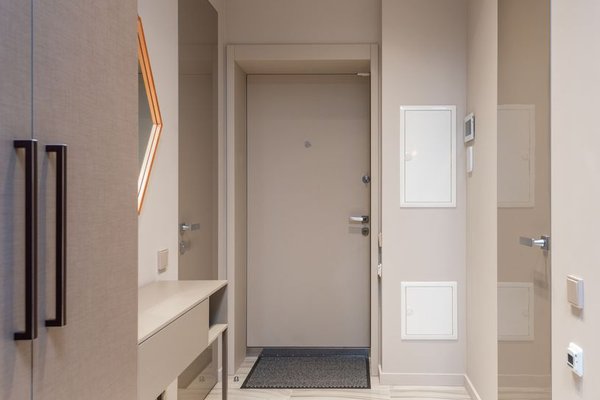
Which entryway furniture for small spaces keeps the walkway clear?
The best entryway furniture for small spaces is narrow, closed where possible, and sized around the walking route first. Aim for a clear path of about 36 inches where feasible, then fit a console no deeper than 8 to 12 inches, a compact shoe cabinet, or a bench only where there is room to sit.
An entryway must handle shoes, keys, coats, and the front door without becoming an obstacle course. Measure the passage at its narrowest point before shopping, and decide which belongings really need to live by the door.
What entryway furniture works in a very small space?
A shallow shoe cabinet, slim console, or narrow wall-mounted shelf usually does the most useful work in a tight entry. A bench earns its footprint only when someone can sit and another person can still pass; furniture that blocks the door is not a storage solution.
Eight furniture ideas that earn their space
- Shallow shoe cabinet: Look for one about 7 to 10 inches deep with tilt-out fronts. It holds everyday pairs upright without toes sticking into the walkway. Verdict: A strong first choice for narrow halls with a useful wall.
- Wall-mounted key ledge: A shelf 4 to 6 inches deep and 18 to 24 inches wide gives keys, mail, and sunglasses a landing spot. Verdict: Practical when floor space is already spoken for.
- Ultra-slim console: A piece 30 to 36 inches wide, 8 to 12 inches deep, and 28 to 32 inches high creates a drop zone. Verdict: Good for a straight wall with no door conflict.
- Compact storage bench: Aim for a seat 30 to 36 inches long, 14 to 16 inches deep, and 17 to 19 inches high. Test its footprint with tape. Verdict: Worth buying only when sitting does not pinch the route.
- Narrow coat stand: A stable model with a base 16 to 18 inches across can serve an entry without a closet. Its footprint grows once bulky coats and bags hang from it. Keep heavy items low. Verdict: Useful in a wider corner, not beside a swinging door.
- Vertical cubby tower: A unit 12 to 15 inches deep and 18 to 24 inches wide makes use of height. Assign each person a compartment for hats or bags, and anchor tall furniture according to its instructions. Verdict: Effective when there is a suitable wall but little floor area.
- Closed basket cabinet: A cupboard about 12 inches deep conceals pet leashes and winter accessories. Measure the clearance needed to pull out drawers or baskets; a cabinet that cannot open is wasted space. Verdict: Best for daily clutter that needs a boundary.
- Fold-down perch: A purpose-built folding seat offers temporary support while someone changes shoes. Confirm its load rating, open projection, wall requirements, and rental permissions; never improvise a seat from a shelf. Verdict: Specialized but useful where mounting is safe and permitted.
Buy one piece before considering a matching set. The broader small spaces furniture principle is to give each footprint one job; storage furniture for small spaces is especially valuable when it closes over clutter.
How deep can an entryway bench or console be?
Measure the usable width, subtract the furniture’s full depth, and check the remaining route. As a practical planning target, preserve roughly 36 inches of unobstructed passage wherever possible; that is not a universal code requirement for every private home.
A 48-inch-wide hallway with a 12-inch-deep console retains 36 inches, assuming no handle or radiator projects into the path. A 42-inch passage with that same console retains only 30 inches. Measure at baseboards, at shoulder height, and with drawers open.
- Preferred clear walking route 36 in wide where feasible
- Slim console depth 8 to 12 in
- Compact bench seat depth 14 to 16 in
- Practical bench seat height 17 to 19 in
- Key ledge projection 4 to 6 in
Mark the outline with painter’s tape, open the front door completely, and carry a grocery bag through the hallway. If you brush the outline or need to turn sideways, reduce the depth before ordering. Remember that a seated person takes up space beyond the bench itself.
Which storage features keep shoes and bags under control?
Closed compartments, assigned places, and accessible hooks manage daily clutter more reliably than a large catchall surface. Plan capacity around what people use this week, not every pair they own, and store the overflow elsewhere.
Make putting things away automatic
- Limit daily shoes: Allow one or two pairs per person near the door and verify cabinet height against real footwear.
- Separate wet items: Set a removable washable tray in a suitable compartment without extending it into the walking route.
- Contain small objects: Assign a tray to keys and a drawer compartment to mail; empty unwanted papers weekly.
- Park bags: Give each regular bag one hook or cubby so straps never lie across the floor.
For a household with children, mark cubbies with names so cleanup is easy to understand. If one purchase needs to perform several jobs, review multifunctional furniture for small spaces and keep only the functions that fit the available area.
How should entryway furniture be placed around doors and walkways?
Keep every piece outside the full door swing and clear of the route toward rooms and stairs. Use the longest uninterrupted wall, then test the arrangement with cabinet doors, drawers, and lids open.
A console occupies floor space while its user is standing; a bench also needs room for knees and feet. The difference matters more in a busy entrance than it does in a carefully staged photo.
| Entryway situation | Slim console | Storage bench |
|---|---|---|
| 48 in straight hall | 12 in depth leaves 36 in clear | 15 in depth leaves 33 in before sitting |
| 42 in passage | 8 in depth leaves 34 in clear | 15 in depth leaves 27 in before sitting |
| Beside inward door | Keep beyond entire door swing | Allow door swing and knee space |
| Storage accessed daily | Drawer needs pull-out clearance | Lid needs overhead access |
| Mobility accommodation | Protect required accessible route | Provide assessed approach space |
In settings subject to accessibility rules, the U.S. Access Board specifies a 36-inch continuous route in many situations, with extra considerations at turns and doors. Requirements for a particular home vary; do not treat a rule of thumb as a compliance check.
A paint choice that does not compete with storage
For repainting, sample Benjamin Moore Pale Oak OC-20; #D8CFC4 is only an illustrative screen reference, not a verified substitute for the physical chip. Use this shade across about 60 percent of visible wall-and-ceiling surfaces, then let furniture remain visually simple.
#D8CFC4 · Benjamin Moore Pale Oak
North-facing light makes the shade look cooler and grayer, while south-facing light increases its warmth; check a real sample in both conditions. Use it on roughly 60 percent of visible surfaces.
Paint cannot fix an obstructed entrance. Keep floor trays within the furniture’s footprint, and leave vents, electrical panels, and exits accessible.
When does small entryway furniture make the space worse?
It fails when the entrance is already too narrow for the chosen footprint. A 15-inch-deep bench in a 42-inch-wide hall leaves just 27 inches before anybody sits. That arrangement may look polished in a staged photograph but becomes frustrating when someone carries groceries. A tiny console covered in mail is not useful storage either; it merely moves clutter from floor level to eye level.
Wall-mounted shelves and fold-down seats are not automatic fixes in rentals. If the lease prohibits drilling or the wall cannot support the load, skip them rather than risk damage or unsafe installation. Tall cubbies and coat stands are also poor choices around young children or pets unless properly secured and stable when loaded.
Benches with baskets underneath often look effortless in photographs, yet baskets project into the path when pulled out, and wet shoes still need space to dry. In a truly cramped entry, the best decision may be no new furniture: use an existing closet, a permitted door organizer, or storage in the next room.
Frequently asked questions
Can a shoe cabinet fit behind the front door?
Only if the door opens fully without contacting the cabinet or its handles. Trace the entire door swing first, and keep shoes clear of that arc.
What should I measure before ordering a narrow console?
Measure wall length, usable depth, baseboards, door swing, and the narrowest walking route. Account for handles and the space needed to pull out a drawer.
Is open shoe storage practical in a tiny entry?
It can work for a small number of daily pairs on a washable tray. Without regular tidying, loose footwear spreads into the route and becomes a tripping hazard.
How can renters add entryway storage without drilling?
Try a stable freestanding cabinet or an over-door organizer permitted by the lease. Make sure nothing interferes with the door latch, safe exit, or clear path.
Does a small entryway need a bench?
No. A bench is only sensible when people can sit while the passage remains clear; otherwise, sit in the nearest room and keep the entry for movement.
Start by protecting the route through the entrance, then select one hardworking storage piece that fits the actual width. Recheck the clearance after coats, shoes, and bags are in their everyday places.