
What storage furniture for small spaces actually fits?
The best storage furniture for small spaces is shallow, enclosed, and sized around your walking paths. Start with a cabinet 12 to 16 in deep, a storage bench where you already need seating, or a low chest that serves as a table. Measure door swings and keep main routes at least 30 in clear.
In a small room, storage succeeds when it replaces another piece of furniture rather than joining the crowd. The checklist below helps you choose useful capacity without blocking light, doors, or the route across the floor.
Which storage furniture gives the most capacity in a small room?
A tall, closed cabinet usually holds the most within a limited floor footprint, provided it can be secured safely and its doors can open fully. A drawer chest or lift-top bench may be the smarter choice when you need everyday access below shoulder height.
Choose by what you need to put away
Before shopping, group belongings into items used daily, weekly, and occasionally. Daily items belong between roughly 18 and 60 in above the floor, where you can reach them without a stool. Labeled bins on an upper shelf are practical for seasonal items; a cabinet packed with tiny open cubbies is harder to keep tidy.
A numbered checklist of storage pieces worth considering
- Shallow closed cabinet: A 12- to 16-in-deep case hides everyday clutter without taking the space of a full-depth dresser.
- Storage bench: A 42- to 48-in-wide bench works especially well where you already sit to put on shoes.
- Low drawer chest: A chest about 30 in high stores folded items while keeping a wall visually open above it.
- Lift-top ottoman: One contained place for throws or games is useful when it also replaces a separate coffee table.
- Wall-secured tall cabinet: Height adds capacity, but choose this only where proper anchoring and safe access are possible.
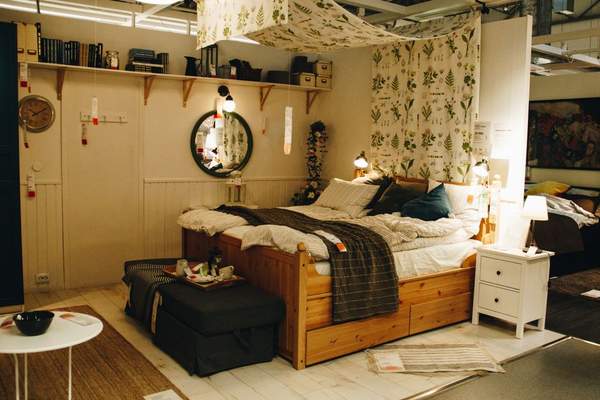
- Bed with integrated drawers: Built-in storage makes sense when its drawers can open without colliding with a wall or nightstand.
- Modular closed cubes: Start with a small configuration and expand only after measuring the remaining walkway.
For more ways to select the right footprint, see small spaces furniture. In particular, multifunctional furniture for small spaces is useful when one item can replace two rather than merely promising extra compartments.
Is vertical storage better than low storage in tight spaces?
Vertical storage can free floor area, but it is not automatically the better fit. Low storage leaves more visible wall and is easier to reach; tall cabinets earn their place when they consolidate objects that would otherwise spread across several pieces.
| Small-room situation | Low enclosed storage | Tall enclosed cabinet |
|---|---|---|
| Need for floor space | Often uses a longer wall run | Concentrates storage in a shorter footprint |
| Everyday access | Drawers and lids stay near waist height | Upper shelves suit occasional-use items |
| Window or sightline | Can sit below a window sill | Needs a clear, uninterrupted wall |
| Stability | Still requires manufacturer safety guidance | Anchoring is especially important |
| Visual weight | Preserves open wall above the piece | Creates a continuous cabinet face |
How deep should cabinets and shelving be in a small room?
For many living rooms and entries, start with closed cabinets 12 to 16 in deep and shelves around 8 to 12 in deep. Choose deeper furniture only when the contents require it, because an extra 4 in can make a narrow passage awkward once doors or drawers are open.
- Closed living-room cabinet depth 12 to 16 in
- Display shelf depth 8 to 12 in
- Main walking route 30 in minimum
- Space in front of drawers 30 in clear
- Storage bench seat height 17 to 19 in
These are planning starting points, not a substitute for the item’s exact specifications or any applicable access requirements. A drawer extending 18 in into a 30-in route temporarily leaves only 12 in to pass. Test how the room works with the storage open, not just with every drawer neatly shut.
For a narrow entrance, entryway furniture for small spaces is most useful when shoe storage does not force people to stand in the doorway. A hinged top also needs clearance above it, so a shelf fixed directly over a bench can make the bench impractical.
Which storage pieces can double as seating or tables?
A lidded bench can replace entry seating, while a firm, stable storage ottoman can serve as an occasional table with a removable tray. A low drawer chest may serve as a side table if its surface is the right height and its drawers remain accessible.
Pick the second job first. For seating, check the manufacturer’s load rating and look for a comfortable height of roughly 17 to 19 in. For a coffee-table substitute, allow around 16 to 18 in between the sofa and ottoman so knees and feet have room; confirm that the lid can still open in that space.
A storage bed is another practical form of space saving furniture for small spaces, but drawer access needs a clear side aisle. Lift-up mechanisms must be operated as instructed, and heavy contents make access less convenient. Don’t buy a clever mechanism until you have tried the movement or reviewed its actual opening dimensions.
How can stored belongings stay out of sight without a heavy-looking cabinet?
Start with fewer separate units, straightforward fronts, and visible floor beneath a piece where the design allows it. A room filled with tiny baskets still looks busy even when everything has a home; an enclosed door hides the irregular shapes of the contents.
If a cabinet can be painted safely according to its finish and manufacturer instructions, Benjamin Moore Pale Oak (#D8CFC4) is one specific wall-and-cabinet color approach. Keep it to roughly 60 percent of the visible room surfaces, including the main walls, rather than treating the entire room as one unbroken block.
#D8CFC4 · Benjamin Moore Pale Oak
It reads slightly warmer and pinker in south-facing light, while north-facing daylight pulls it grayer. Use it across roughly 60 percent of the visible room surfaces and sample it beside the furniture before committing.
Before purchasing, photograph the room from its doorway at standing eye level. The photo can reveal where a tall shape interrupts a window or where three narrow units look like more furniture than one useful cabinet. Choose compact furniture for small spaces based on the footprint you can accommodate, not the number of hidden compartments promised.
Looking for furniture for small spaces with storage should begin with the measured contents and the exact space you can spare. One working cabinet provides better evidence of what is missing than a complete set chosen from a staged photo.
When does extra storage furniture make a small room worse?
It fails when the new piece takes over the only usable walkway, blocks a window, or turns every wall into a bank of cabinets. Floor-to-ceiling storage photographed from a wide-angle viewpoint often looks effortless because the room is empty and the cabinet doors are shut. In daily life, those doors need space, high shelves need safe access, and a person still needs to cross the room.
Do not put a freestanding tall unit in a home with children without following the manufacturer’s anchoring instructions. A rental agreement that prohibits drilling may rule out a tall cabinet requiring wall attachment; choose a safely suitable alternative rather than skipping the anchor. Do not improvise structural fixings or assume adhesive strips prevent tip-overs.
Lift-top benches are poor choices for heavy, frequently used items if opening the lid means moving cushions and people every time. Open shelving also rarely conceals visual clutter, regardless of how tidy the promotional photo looks. On a limited budget, removing duplicates and organizing one existing cabinet can deliver more practical space than buying another unit.
Frequently asked questions
Can a storage cabinet fit behind a sofa?
Yes, if the sofa remains usable and there is enough clearance to open the cabinet safely. Measure the cabinet depth and the actual walking route, not merely the gap between the sofa and wall.
Are open shelves practical for everyday clutter?
They work for a small number of objects you can maintain easily, but loose cables, packaging, and mixed-size items stay visually exposed. Closed storage is usually easier to keep looking orderly.
Should a storage bench have drawers or a lifting lid?
Choose drawers when you need quick access and have room for them to extend forward. A lifting lid works for less frequently used items if nothing fixed above it prevents opening.
Can I anchor tall storage furniture in a rental?
Ask the landlord or property manager about approved wall fixings before buying a unit that requires anchoring. Follow the manufacturer’s instructions and use an appropriately qualified installer if the wall construction or fastener choice is uncertain.
How do I avoid buying storage I will quickly outgrow?
Measure the items that need a home and leave a modest amount of usable space for changes. Favor adjustable shelves and replace-one-piece solutions over several small cabinets bought on impulse.
The right unit removes clutter without asking the room to give up its easiest route or most useful light. Measure the open furniture as carefully as the closed furniture, and buy one well-chosen piece before adding another.