
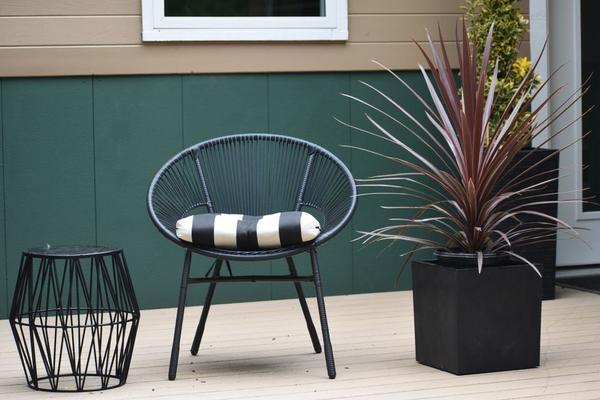
What deck furniture small spaces can actually fit?
For deck furniture small spaces can use comfortably, choose a wall-side bench, two folding chairs, or a narrow bistro set, and keep a continuous 30-inch walking route from the door to the steps. Measure furniture in its occupied position, not folded or tucked in. Avoid deep loungers and oversized dining sets on decks under 80 square feet.
A compact deck should work when someone is sitting, carrying dinner outside, or opening the door—not just when the chairs are pushed in. Use this checklist to find pieces that fit the actual footprint and leave a sensible path through it.
What furniture works best on a small deck?
Start with seating that stays close to the perimeter and tables that do not need a wide pull-out zone. The best pieces are easy to shift or store without turning every trip outside into a furniture-moving exercise.
Check these furniture choices before buying
- Shallow wall-side bench: A bench about 16 to 18 inches deep supplies seating without the clearance needed to pull out individual chairs.
- Two folding side chairs: Chairs about 18 to 21 inches wide can hang or stack away when the deck needs its full floor area.
- Round bistro tabletop: A 24-inch diameter surface works for two drinks or light meals while avoiding projecting corners.
- Rail-mounted drop-leaf table: A compact leaf about 12 to 16 inches deep is useful only when its mounting is permitted and structurally appropriate.
- Small nesting side tables: Tops roughly 14 to 18 inches wide give guests a landing spot and can separate when needed.
- Storage bench with a lift-up lid: Choose a shallow model that allows the lid to open fully without hitting railings or people.
- Compact backless stool: A stool with a seat near 15 inches square can tuck beneath a suitable table between visits.
Prioritize outdoor-rated pieces with stable feet and wipe-clean surfaces. Shopping for deck furniture for small spaces is easier when you compare open dimensions with your sketch, not staged product photos.
If an existing privacy screen is paintable and you own it or have permission, Benjamin Moore Pale Oak, represented here by #D8CFC4, provides a specific backdrop. Reserve that finish for about 60 percent of the visible vertical screen area.
#D8CFC4 · Benjamin Moore Pale Oak
On a north-facing covered deck it can look grayer; in south-facing sun it reads warmer and slightly pinker. Use it on roughly 60 percent of the visible, paintable privacy-screen area after checking a physical sample outdoors.
The principle behind small spaces furniture is buying for the usable walking route, not just a product’s footprint.
How should you size a table and chairs for a compact deck?
Measure the clear deck surface between railings, walls, planters, and the door’s swing. Then draw every chair in its pulled-out position and mark a walking route that stays usable when people are seated.
Use the occupied footprint, not the catalog photo
A 24-inch round bistro table might look tiny in a showroom, but two people still need knee room and a place to pull their chairs back. Tape the tabletop outline on the deck, set actual chairs or boxes around it, and walk from the doorway toward the stairs with a laundry basket held at your side. If you must turn sideways, the setup is too tight.
- Primary walking route 30 in clear minimum
- Comfortable door-to-steps route 36 in clear
- Two-person bistro tabletop 24 in diameter
- Space to pull a dining chair back 24 in beyond table edge
- Perimeter seating bench depth 16 to 18 in
- Compact folding chair width 18 to 21 in
These are planning dimensions, not guarantees of code compliance or accessibility. Check local rules for your deck, especially near stairs, exits, and guards. A 36-inch path is a more forgiving target when someone regularly carries food outdoors or needs to pass another person.
On an 8-by-10-foot deck, the 8-foot side measures 96 inches before anything projects inward. An 18-inch bench, 24-inch table, 24-inch chair-use zone, and 30-inch route total exactly 96 inches. That leaves nothing for a railing post, angled chair leg, or open door; shrink the table or remove a chair from that side.
Which deck furniture layouts preserve the best walking path?
Put the main travel line between the door and stairs or gate on your sketch first. Arrange seating alongside that line, with tables accessible from the seats rather than planted in the middle of the route.
Compare a perimeter bench with centered dining
| Deck use | Wall-side bench layout | Centered dining layout |
|---|---|---|
| Best deck width | Often workable from about 6 ft with a shallow bench | Needs more width for chairs on both sides |
| Seating movement | Bench stays in place without chair pull-back | Chairs need about 24 in of pull-back space |
| Door-to-stairs route | Can reserve a straight 30 to 36 in corridor | May force traffic around occupied chairs |
| Serving a meal | Works with a movable 18 to 24 in table | Conventional dining table uses more floor area |
| Empty-deck flexibility | Floor stays open beside the bench | Furniture remains in the deck’s center |
For a narrow 6-by-8-foot deck, a single bench near one long edge can leave room to walk without passing between chair backs. Do not put a seat where someone must stand in the stair approach to get up. On an 8-by-10-foot deck, tuck a folding bistro set beside the railing and keep the most direct route unbroken.
Make a full-size test with painter’s tape or cardboard. Stand at the doorway with it open, imagine two people seated, and verify a guest can reach the steps without anyone moving. A deck that measures 80 square feet on paper loses usable floor area to posts, rails, and a grill.
What storage or folding features help on a small deck?
Look for furniture that folds flat, nests securely, or serves a second purpose without needing extra space to operate. Storage only helps if you can reach it when the deck is furnished and the door is open.
Check the mechanism before choosing it
- Folding chairs: Check folded thickness and where both chairs will live; even a 5-inch-thick chair needs a secure storage spot.
- Lift-top benches: Check the manufacturer’s lid-clearance drawing; nearby railings can block the hinge.
- Drop-leaf surfaces: Verify the leaf locks and leaves the 30-inch path clear when raised.
- Stacking stools: Check total stack height so the stack cannot tip or interfere with the door.
For renters, freestanding folding furniture for small spaces is practical because nothing must be drilled into siding or guards. For pieces that serve two purposes, see storage furniture for small spaces; related entry routes appear in porch furniture small spaces.
When does compact deck furniture still fail?
A furnished deck may be too small for both dining and through-traffic. On a 6-foot-wide platform, a full table with chairs on opposite sides can consume the space needed to reach stairs safely. Product photos hide this by showing chairs tucked under the table, nobody seated, and no open door. A bench can also fail if it projects into the stair landing or blocks access to a hose bib, gate latch, or exterior outlet.
Rail-hung tables look especially tidy in photographs, but they are wrong for a rental without explicit permission and may be unsuitable for a guardrail that was never designed to support the added load. Do not drill a railing or alter a structural member to make furniture fit; ask a qualified professional about structural changes. The same caution applies to built-in seating attached to a deck.
With small children or pets, lightweight folding pieces can tip, pinch fingers, or shift across the boards. Wind can move unsecured furniture, too. If you cannot maintain a clear exit route after people sit down, buy fewer pieces—even if that means keeping only one bench and a removable side table.
Frequently asked questions
Can two people eat on a deck only 6 feet wide?
Yes, if you use a shallow table and keep both seats near the perimeter. Mark the door swing and preserve at least a 30-inch circulation route before buying anything.
Are round tables practical on narrow decks?
A 24-inch round table can serve two people for drinks and simple meals. Its useful footprint includes pulled-out chairs, so measure the entire setup rather than the tabletop alone.
How do I stop folding chairs from cluttering the deck?
Choose a designated storage spot before ordering them and confirm its width, depth, and height. Bring chairs inside during weather beyond the manufacturer’s outdoor-use recommendations.
Can I put a storage bench against a deck railing?
A freestanding bench may fit if it does not interfere with the guardrail, stairs, or required circulation space. Check lid clearance and avoid fastening anything to a railing without approval.
Start by drawing the path you need to walk, then fill the remaining edges with just enough seating and surface area for how you use the deck. If the taped layout feels crowded, remove a piece before you spend money on it.