
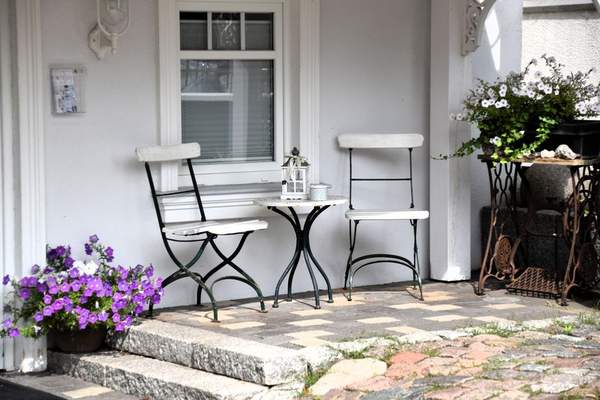
What porch furniture small spaces can actually fit?
For porch furniture small spaces can use comfortably, start with a 16- to 20-inch-deep chair, a narrow bench, or a folding bistro set. Keep a continuous walking route at least 36 inches wide where possible, leave the door’s full swing unobstructed, and buy only after measuring the porch’s usable depth.
A small porch can hold a place to sit without becoming an obstacle course. The trick is to plan the walk from the steps to the front door first, then assign the remaining space to furniture that earns its footprint.
What porch furniture fits a narrow porch?
On a narrow porch, the strongest choices sit close to the wall and have compact legs, arms, or backs. A single chair, a slim bench, or a foldaway set can work, but only if the door, railing, and main walking path still function.
Five arrangements worth measuring first
These options cover most ordinary porch shapes. Treat the dimensions as shopping targets, not promises about a particular product: check the manufacturer’s actual overall measurements, including feet and armrests.
- One wall-side chair: A chair about 18 inches wide and 20 inches deep gives one person a real seat without committing the entire porch to a conversation set. Position its back toward a solid wall, not across the door approach. Verdict: best for a porch that needs seating more than entertaining.
- A narrow backless bench: Look for a bench roughly 36 to 42 inches long and 14 to 16 inches deep. Without a back projecting into the route, it can tuck along a wall and serve briefly as a place to set shopping bags. Verdict: useful when two people occasionally need a perch.
- A folding bistro chair: Choose a chair that folds to a shallow stored profile and can be moved indoors between uses. Mark its fully opened legs on the floor with removable painter’s tape before buying. Verdict: flexible seating when the porch is too narrow for a permanent pair.
- A wall-hugging chair and tiny table: Pair one armless chair with a small table measuring around 12 inches across. Position the table beside the seat, never within the main route, and avoid projecting feet that catch shoes. Verdict: enough for a drink and a book, without building an outdoor living room.
- A foldable two-seat setup: Two folding chairs may suit a wider landing when they can be stored after use rather than left blocking circulation. Measure both occupied chair positions, because knees and pulled-out seats require extra space. Verdict: occasional company without a permanently crowded porch.
For other tight footprints, the same measuring-first logic applies to small spaces furniture. If the porch also acts as a drop zone, ideas from entryway furniture for small spaces can help you keep bags and shoes off the route.
How much clearance should a porch seating area have?
Plan a clear walking strip of about 36 inches from the approach to the door whenever the porch allows it. Measure from the farthest furniture projection, not from the chair’s back, and make sure an open door does not collide with the seating.
First measure the porch’s narrowest usable width, excluding posts and projecting trim. Then mark the intended chair or bench on the floor and stand where a seated person’s knees would reach; a nominally compact seat can still feel intrusive once occupied. Keep the landing and required exit route free, and check applicable local building and accessibility rules rather than treating these planning figures as legal minimums.
- Preferred uninterrupted walking route 36 in wide
- Compact chair shopping depth 18 to 20 in
- Slim bench seat depth 14 to 16 in
- Small side-table diameter 12 in
- Clear space between seat edge and side table 4 to 6 in
For a porch 60 inches deep, a 20-inch-deep seat leaves a theoretical 40-inch strip before allowing for any projecting legs or occupied knees. For a porch only 48 inches deep, that same seat leaves 28 inches, so a permanent chair may be a poor fit even if it physically fits against the wall. Tape out these footprints while the door is open.
Which chair and table shapes work best in a small porch?
Choose forms that stay within predictable outlines: armless chairs, straight benches, and small tables without splayed feet. A round tabletop can be useful beside one seat; rectangular pieces align neatly with a wall when every inch matters.
| Porch constraint | Armless chair with round side table | Straight narrow bench |
|---|---|---|
| Usable depth | Allow about 20 in for chair plus leg movement | Seek 14 to 16 in seat depth |
| Seating capacity | One seated adult | One or two adults, depending on length |
| Wall placement | Chair back against wall; table beside seat | Long edge parallel to wall |
| Everyday access | Table must not intrude into walkway | Bench ends must avoid door swing |
| Storage flexibility | Chair can be folded if chosen accordingly | Usually stays in place |
Check each product’s overall width, not just its seat width. Curved arms, flared legs, and thick cushions can extend beyond the dimensions shown in styled photographs. For porches that double as occasional seating areas, folding furniture for small spaces is a sensible next place to look.
How can you make a small porch feel finished without overfurnishing it?
Give the porch one clear seating purpose, then repeat a small number of details rather than adding more furniture. A washable cushion, one compact planter, and a coordinated painted surface can establish a finished look without taking away floor area.
If repainting is permitted and the surface is suitable, Benjamin Moore Pale Oak, represented here by #D8CFC4, is one specific backdrop to sample on a porch wall. Use an exterior-rated coating specified for the substrate, and judge the actual dried sample outdoors rather than trusting a screen color.
#D8CFC4 · Benjamin Moore Pale Oak
On a north-facing porch it tends to read cooler and grayer, while strong south-facing daylight makes it appear warmer. Let it cover roughly 60 percent of visible vertical surfaces if you use it as the dominant paint color.
Leave the remaining surfaces in their existing finishes unless you are deliberately planning a larger exterior paint project. Choose a cushion cover that can be removed for cleaning, place the planter outside the circulation strip, and avoid an outdoor rug that bunches near the threshold. On a rental porch, removable objects are the safer finish.
The most effective porch furniture for small spaces does not make visitors sidestep a table to reach the bell. Likewise, compact furniture for small spaces should remain easy to lift, clean around, and store before severe weather.
When does adding porch furniture make the space worse?
If your porch is the only route into the home and a seated person’s knees block that route, skip the chair. The staged photograph of two rocking chairs flanking a front door usually ignores the room needed for rocking, door clearance, deliveries, and a person carrying groceries. On a landing 48 inches deep, even one 20-inch chair can consume space that would be better left open.
A small bench is not a safe workaround if it obstructs a required exit, accessible route, or door maneuvering area. Building and accessibility obligations vary; check local requirements, particularly in shared buildings. Do not attach a wall-mounted seat to rental siding or drill into railings without written approval. If the porch is exposed to wind, lightweight folding furniture can move or tip and should be brought inside when not in use.
Skip floor accessories where puddles collect or the threshold becomes slippery. If pets, small children, or people using mobility aids share this entry, a clear, predictable walking path is more valuable than any extra seat. Sometimes the best finished porch has no furniture at all.
Frequently asked questions
Can a porch only four feet deep hold a chair?
It may physically hold a shallow chair, but a 20-inch-deep seat leaves only 28 inches before accounting for feet or knees. If that strip is the required path to your door, leave the porch clear or use seating that can be removed after use.
Should I buy an outdoor rug for a tiny porch?
Only if it lies flat, has suitable outdoor backing, and stays well away from the door’s swing and threshold. A rug that curls or holds rainwater can create a trip or slip hazard, so bare flooring is often preferable.
Can indoor dining chairs be used on a covered porch?
A roof does not eliminate humidity, wind-driven rain, or sun exposure. Use furniture rated for the exposure it will actually experience, and follow the manufacturer’s care instructions.
Where should a small porch table go?
Set it beside the seated person’s arm, close to the wall, and outside the approach to the door. A table near 12 inches in diameter is often sufficient for one mug, but its legs must remain clear of foot traffic.
How do I test a layout before ordering furniture?
Measure the widest projection of each piece and outline it with removable tape. Open the door fully, walk through while carrying a bag, and repeat the test with someone seated in the marked footprint.
Measure the entry path first, then give the leftover area one job it can perform comfortably. A carefully placed seat is useful; a clear door and safe passage are nonnegotiable.