
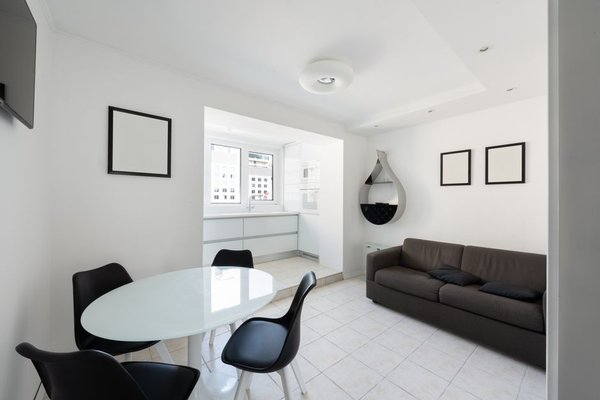
What small living room furniture works best in a flexible layout?
The best small living room furniture has a compact footprint, performs more than one job, and can move as your layout changes. Start with a 68- to 76-inch sofa, add nesting tables or a storage ottoman, and keep at least 30 inches of clear walking space through the room whenever possible.
A small living room does not need miniature furniture everywhere. The right small living room furniture fits the room, leaves enough open floor to move comfortably, and can adapt for daily use or guests without turning every rearrangement into a project.
What’s the best furniture layout for a small living room?
The best layout usually gives the largest seat one clear home, keeps the main walkway open, and uses smaller movable pieces around it. In many rooms, placing a compact sofa on the longest usable wall creates a reliable starting point, but the final arrangement should follow doors, windows, TV position, and the route people actually walk.
Before buying anything, measure the room wall to wall, then mark door swings, radiators, floor vents, windows, and built-ins. If your current room is difficult to organize, Furniture Layout & Space Planning gives you the broader planning framework, while how to arrange furniture in a small living room is the more direct next step for placement.
Keep the largest visual mass close to a wall unless the room is wide enough to support circulation behind it. Floating a sofa can work, but only when you can preserve a usable path rather than leaving a narrow strip that looks open on a floor plan and feels awkward in real life. In a room around 10 by 12 feet, every extra 6 inches of furniture depth matters.
What furniture works best in a small living room?
Choose furniture that is compact in depth, easy to move, or useful for more than one purpose. The strongest buys are usually a properly scaled sofa, flexible tables, closed storage, and narrow surfaces that do not block circulation.
- 68- to 76-inch apartment sofa: Best all-around choice when you need comfortable everyday seating without giving the sofa the entire room.
- Modular sofa: Best for layouts that change often because sections can be separated, turned, or reconfigured as the room needs change.
- Nesting tables: Best when you need occasional surface area but do not want a full-size coffee table occupying the center of the room all day.
- Storage ottoman: Best multiuse piece for hidden storage, an extra seat, and a soft footrest in one footprint.
- Slim console: Best for a wall, sofa back, or entry edge where you need a surface without the depth of a cabinet or desk.
- Armless accent chair: Best for occasional extra seating because the missing arms reduce visual and physical width.
A storage ottoman can replace a separate footstool and storage basket, while nesting tables can be split when guests need somewhere to set a drink and stacked again afterward. A slim console around 10 to 14 inches deep can add a useful landing surface without projecting far into the room.
| Living-room need | Apartment sofa | Modular sofa |
|---|---|---|
| Typical width to target | About 68 to 76 inches | Depends on section count; two compact modules may start near the same range |
| Typical depth to target | About 32 to 36 inches | Check each module; deep lounge modules can exceed 38 inches |
| Layout flexibility | Fixed shape, easy to plan around | Sections can be rearranged or separated |
| Moving through tight doors | One larger frame can be harder to maneuver | Separate modules are often easier to carry individually |
| Budget pattern | Usually one complete purchase with a clear upfront cost | Total cost can rise as extra sections or specialty modules are added |
| Best fit | Stable everyday layout with one main seating zone | Rooms that shift between lounging, guests, and entertaining |
Do not assume a modular sofa is automatically smaller. Some modules are unusually deep, and adding a corner section can consume more floor area than a straightforward apartment sofa. Measure the full assembled footprint, not just one module.
How much space should you leave around living room furniture?
Aim for about 30 to 36 inches on the main walking route when the room allows it, and avoid squeezing frequently used passages below about 24 inches. Between a sofa and coffee table, roughly 14 to 18 inches usually keeps the table reachable without making the seating area difficult to enter.
- Main walkway: 30 to 36 inches is comfortable for regular traffic.
- Tight secondary passage: About 24 inches can work where traffic is occasional, but it will feel noticeably tighter.
- Sofa to coffee table: About 14 to 18 inches keeps drinks within reach while preserving legroom.
- Chair pull-out space: Allow roughly 18 to 24 inches in front of an occasional chair for legs and movement.
- Console depth: About 10 to 14 inches is a useful target where a deeper cabinet would pinch the route.
These are practical targets, not reasons to force a piece into a room. If maintaining the main path means pushing the coffee table against the sofa or leaving only a few inches around a chair, remove or replace the problem piece. A pair of small nesting tables is often easier to live with than one large rectangular table in a narrow room.
Pay particular attention to doorways and the route from the room entrance to the most-used seat. A layout can look balanced from the center of the room and still fail if someone must walk around a table corner every time they enter. For additional layout examples, small living room layout ideas can help you test alternatives before buying.
Are modular sofas good for small spaces?
Yes, modular sofas can be very useful in small spaces when the individual modules are genuinely compact and the room benefits from changing configurations. They are less useful when each section is deep, the connectors are bulky, or the layout only works in one fixed arrangement anyway.
Modular seating makes the most sense for renters, frequent movers, and rooms that perform several jobs. You can separate sections for guests, move one module aside for exercise or play space, or rebuild the sofa after moving to a different home. If you rarely rearrange the room, a compact fixed sofa may be simpler and may leave more budget for storage or lighting.
When does flexible furniture not work in a small living room?
Flexible furniture fails when every piece is technically movable but there is nowhere useful to move it. A tiny room packed with a modular sofa, nesting tables, an ottoman, two stools, and a console can still feel like a storage unit for furniture. Photos often make this look workable because the pieces are styled apart for the picture, not shown during normal daily traffic.
A deep modular sofa is also a poor choice when the room is narrow. If a 40-inch-deep seat leaves only a 20-inch passage, its flexibility does not solve the basic space problem. The same applies to oversized storage ottomans that must be dragged away every time you open them, or nesting tables that have no clear place to separate.
On a tight budget, do not pay extra for moving parts or modules you will never use. In a rental, avoid any layout that depends on drilling into walls, removing fixed fittings, or altering the property. The best small room is not the one with the most clever furniture; it is the one with enough furniture and clear floor left over.
How to shop without buying the room twice
Measure the room, then measure the delivery route. Record the narrowest doorway, hallway turn, stair width, and elevator opening if applicable. Retail dimensions can be accurate while the product still proves impossible to maneuver into position.
When shopping for small living room furniture online, save the listed dimensions and mark each footprint with painter’s tape. Check return and restocking policies before ordering bulky furniture, especially boxed modular systems, because an unsuitable low-price piece can become expensive to send back.
Frequently asked questions
Should a small living room have a coffee table?
Not necessarily. If a standard coffee table interrupts the main walkway, use nesting tables, a small C-table, or an ottoman tray instead so surface space can appear only when you need it.
What sofa depth is best for a small living room?
A sofa around 32 to 36 inches deep is a useful starting range for many compact rooms. Always measure the remaining walkway after placing the full sofa footprint, because arm shape, wall position, and room width matter as much as depth alone.
Is furniture with exposed legs better in a small room?
Exposed legs can make more floor visible, which may help a room look less visually heavy, but they do not create extra usable square footage. Choose them for appearance only after the width, depth, storage, and circulation needs are solved.
Can a storage ottoman replace a coffee table?
Yes, especially if you use a stable tray for drinks or small items. It works best when the lid is easy to open and there is enough surrounding clearance to access the storage without moving several other pieces first.
How do I know if furniture is too big before I buy it?
Mark the exact width and depth on the floor with painter’s tape, then walk the normal routes through the room. If doors cannot open fully, the main path falls below about 24 inches, or you must turn sideways to pass, the piece is too large for that position.
Good small living room furniture earns its floor space by fitting the room, supporting daily routines, and leaving a clear route through the layout. Start with the main seat, measure every clearance, then add only the storage and surfaces you will actually use; flexibility comes from having room to move pieces, not simply owning movable pieces.
Sources and Further Reading
- American Society of Interior Designers – professional interior design resources and space-planning context
- Cooper Hewitt, Smithsonian Design Museum – design education, furniture and object design resources
- IKEA United States – furniture dimensions and examples of compact and modular furniture formats