
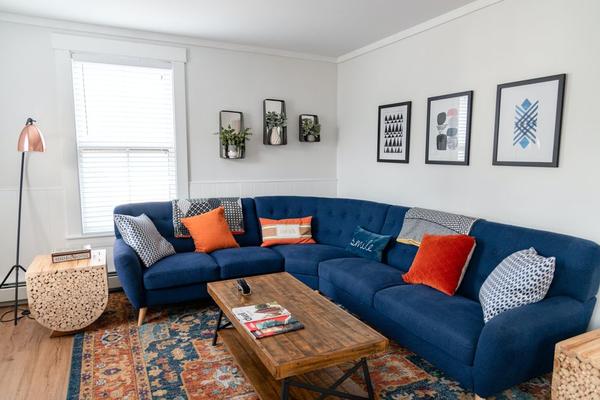
How do you choose sectional furniture for small spaces?
Choose sectional furniture for small spaces by measuring the full footprint, including the chaise, then protecting a 30-inch walking route and 16 to 18 inches between the sofa and coffee table. Start with a compact model about 72 to 84 inches wide, check door swings, and tape its exact outline onto the floor before ordering.
A sectional can make a small living room feel organized instead of crowded, but its footprint matters more than the seat count in a product photo. Start with the traffic pattern, then choose the shape that stays outside it.
What size sectional fits a small living room?
In a roughly 10 x 12 ft living room, begin with sectionals around 72 to 84 inches wide and a chaise projection near 50 to 60 inches. Those are shopping filters, not guarantees: a doorway or narrow passage can rule out a model that seems suitable. Measure the usable floor area before choosing.
Draw the room and mark windows needing access, heaters, outlets, doors, and the route from the entry to the next room. Check the manufacturer’s overall width, depth, chaise projection, and arm height rather than relying on the number of seats. If the coffee table will stay, put its outline on the plan too.
A room that technically holds an 88-inch sofa may be easier to use with a 76-inch one, especially if people regularly move past it. The goal is usable seating without making everyone edge around the furniture.
- Compact sectional overall width 72 to 84 in
- Typical compact chaise projection 50 to 60 in
- Sofa to coffee table gap 16 to 18 in
- Primary walking route 30 in minimum
- Preferred busy walkway 36 in
Tape the complete outline on the floor. Sit at the planned cushion position and confirm you can stand, reach the table, and walk past without stepping sideways.
Which sectional shapes use the least floor space?
A compact sofa with one chaise often has the simplest footprint because only one seat projects into the room. A two-piece L sectional can work in a corner if its return stays clear of doors. Wall lengths and circulation routes determine which works, not the furniture category alone.
The term compact furniture for small spaces should mean verified measurements, not just a seller’s styling. Use this comparison before testing any configuration on the floor.
| Room condition | Compact chaise sectional | Two-piece L sectional |
|---|---|---|
| Main wall available | Look for about 72 to 84 in | Measure both adjoining walls |
| Projection into room | Chaise often reaches 50 to 60 in | Return may reach 55 to 70 in |
| Door near corner | Face chaise away from door swing | Return may block entry access |
| Later rearrangement | Reversible chaise may switch sides | Separate pieces may reconnect differently |
| Specification to inspect | Chaise side and full depth | Both legs and connector positions |
Inspect the arms: a narrow arm preserves seat width without increasing the overall footprint. Models with interchangeable sections deserve attention; modular furniture for small spaces is useful when your layout may change after a move.
How should a sectional be positioned around doors and walkways?
Place its long side along the most uninterrupted wall, keeping the chaise outside the route between doors. Open every door completely while checking the taped footprint. If a door touches that outline, change the position or model.
Start with the movement you cannot negotiate: reaching a hallway, opening a patio door, or carrying groceries. Mark the route with two strips of painter’s tape 30 inches apart. For a busy passage, aim for 36 inches so carrying laundry does not become an obstacle course.
Do not block a window that must open, a heating vent, or a closet. If the sectional floats in the room, check behind it as well as in front. Point the chaise into the seating area, not into circulation space. A low back can keep sightlines open, but it never compensates for inadequate clearance.
If shoes and bags crowd the entrance, consider entryway furniture for small spaces so that overflow does not steal the living room’s narrow walking route.
How much clearance should you leave around a sectional?
Allow 16 to 18 inches from the front of the seating to the coffee table, with at least 30 inches along a necessary walking route. Aim for 36 inches where people carry items past the sofa. Check each distance at its tightest pinch point.
Measure from the most projecting arm or chaise edge, not from a cushion seam. Include the coffee table, side table, and space needed to open storage. A comfortable reach between sofa and table is not a walkway; avoid making it the main route through the room.
An 8 x 10 ft rug can connect the arrangement when the front sofa legs rest on it. Tape its footprint before buying too, and ensure the rug does not create a trip point in a doorway. A rug centered for a showroom photo may be awkward in daily use.
Which compact sectional should you shortlist first?
Use these numbered picks as a shopping shortlist, then inspect each manufacturer’s actual specifications. Buy for the way the room works, not the way a catalog stages it.
- Two-seat sofa with reversible chaise: Best first look if you may switch the chaise side.
- Short-arm modular sectional: Useful when pieces must pass through an apartment doorway.
- Apartment-scale corner sectional: Worth measuring where two uninterrupted walls meet.
- Sectional with visible legs: Good if more exposed floor will lighten the silhouette.
- Storage-chaise sectional: Practical only when its compartment opens completely.
For a room full of blankets or devices, consider storage furniture for small spaces alongside the sofa. Avoid paying for inaccessible storage that looks impressive on a product page.
Can wall color help the seating feel less bulky?
Paint cannot rescue an oversized sectional, but a consistent background can make the room feel calmer. If painting is permitted, consider Benjamin Moore Pale Oak OC-20, represented here by #D8CFC4; sample the real paint first because screens cannot show an exact match.
#D8CFC4 · Benjamin Moore Pale Oak
In north-facing daylight it reads grayer, while south-facing light brings out its warmer cast. Use it across roughly 60 percent of visible surfaces, mainly walls and ceiling.
Repeat existing materials instead of adding several competing finishes. This also suits modern furniture for small spaces, where a restrained arrangement preserves attention on the open floor. Renters should use removable samples and obtain permission before painting.
When is a sectional the wrong choice for a small room?
A sectional is wrong when it forces people to squeeze around a chaise, blocks a door, or prevents a cabinet from opening. If the only passage left is 22 inches wide, you have lost basic function. A regular sofa and movable chair may fit better, even if that arrangement looks less exciting in a catalog.
Be skeptical of photographs with a sectional almost touching the coffee table. Those rooms are arranged for one camera angle, not someone bringing groceries through. A massive corner model under a window may look balanced in a wide-angle image while making the actual room difficult to enter. Deep seats sound appealing until the chaise takes the only space where children can play.
In a rental, do not assume you can remove doors, alter built-ins, or change a heater to make furniture fit. With pets, inspect cleaning instructions and removable covers before ordering; complicated fixed sections may be harder to maintain. And if delivery crews cannot turn the components through a hallway or stair landing, even a perfect floor plan is useless. Measure the access route before spending.
Frequently asked questions
Is a reversible chaise worth paying for?
Yes, if you might move or rearrange, because it provides another orientation. Check the instructions first; switching sides can sometimes require disassembly.
Should a small sectional sit against the wall?
It often can when floor area is tight and the wall is uninterrupted. Keep any clearance required by heaters and ensure outlets and windows stay accessible.
Can I use a sectional in a studio apartment?
Yes, if it defines seating without cutting off routes between the kitchen, sleeping space, and door. Tape the entire footprint and test the paths with your other furniture in place.
What should I measure for sectional delivery?
Measure the narrowest doorway, hallway, stair landing, and elevator interior where relevant. Ask for the dimensions of each shipping carton or component, not just the assembled sofa.
Does a storage chaise replace a cabinet?
It can store blankets or occasional items, but the lid or drawer must open fully. Test access with the coffee table in its normal position before relying on it for daily storage.
Successful sectional furniture for small spaces leaves a clear path, comfortable reach to the table, and working doors. Measure the exact model, tape its outline, and let the room rather than the product photo decide.