
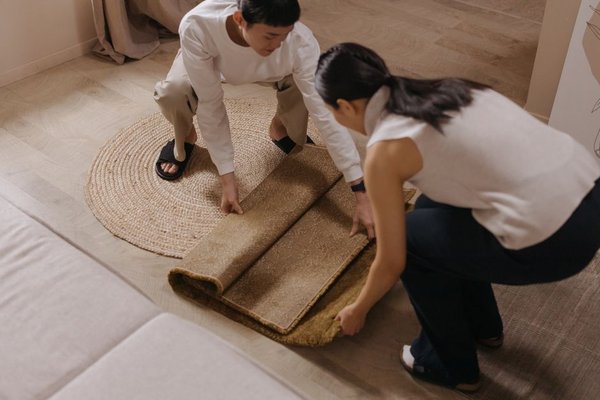
Are thick rugs for living room spaces practical?
Thick rugs for living room spaces work best when the pile and pad stay clear of swinging doors, floor vents, and low furniture. Aim for a comfortable but controlled surface, usually about 1/2 to 3/4 in total underfoot, and measure every door path before buying so softness does not create daily friction.
A thicker rug can make a living room feel quieter and more comfortable, but comfort is only useful if doors still open, furniture stays stable, and cleaning is manageable. The best choice is usually not the deepest pile you can find, but the thickest surface your room can use without creating clearance problems.
How thick should a living room rug be?
For most living rooms, a rug and pad that finish around 1/2 to 3/4 in thick gives noticeable cushioning without becoming difficult to live with. Go thicker only where no door swings across the rug and where chair, table, and sofa legs sit securely.
Start by checking the rug’s stated pile height, then add the pad thickness. A 1/2 in pile on a 1/4 in pad creates a 3/4 in stack, which can feel substantial without the deep sink of a very long shag. This is especially useful when the rug sits under the front legs of a sofa rather than across the entire floor.
If the goal is a softer seating zone, plush rugs for living room use can work well because dense fibers can feel cushioned without needing extremely long strands. A dense medium pile is easier to place beneath furniture than a loose, very deep surface that lets table legs settle unevenly.
Use the main living room rug plan to decide where the rug will stop before you shop for thickness. Size and placement come first because a thick rug in the wrong footprint creates more trouble than a thinner rug that fits the seating area correctly.
- Finished rug plus pad under a door path 1/2 in maximum when the door bottom has 5/8 in clearance
- Rug under sofa front legs 8 to 12 in
- Sofa to coffee table 16 to 18 in
- Bare floor around a centered area rug 12 in
- Rug pad inset from rug edge 1 in on every side
Do thick rugs make doors or furniture harder to use?
Yes, they can. Doors need vertical clearance, while tables and chairs need enough support that their legs do not tilt or wobble when some legs sit on the rug and others sit on bare flooring.
Keep a thick rug completely outside a tight door swing whenever possible. If the rug must cross that path, use the measured floor-to-door gap rather than guessing from the product description. A 5/8 in gap, for example, should not be filled by a 5/8 in rug-and-pad stack because normal movement and slight floor variation can still cause rubbing.
Furniture works best when all legs of a small table sit on the same surface. A sofa can sit with only its front legs on the rug; for exact placement, use living room rug layout rather than choosing pile height in isolation.
For rooms where the rug must sit close to painted walls, Benjamin Moore Pale Oak OC-20 with the match value #D8CFC4 is a practical light background because it lets the texture of a thicker rug remain the visual focus instead of competing with it.
#D8CFC4 · Benjamin Moore Pale Oak
Reads warmer and slightly pinker in south-facing light, while north-facing light pulls it noticeably grayer. Use it on the main walls, roughly 60 percent of the visible room color.
Which rug materials feel thick without being too soft?
Dense wool, tightly constructed nylon, and some short-pile synthetic rugs can feel substantial without the loose sink of extra-long fibers. The key is density: closely packed fibers support feet and furniture better than a tall but sparse pile.
- Wool: naturally springy and substantial, especially in a dense cut or loop construction.
- Nylon: resilient under furniture and suitable where the seating area gets frequent foot traffic.
- Polypropylene: often used in practical synthetic rugs and available in denser constructions that do not need a very tall pile.
- Polyester: can feel soft and full, but the exact result depends heavily on fiber density and construction.
If you like fluffy rugs for living room settings, try a shorter dense surface before very long fibers. A shag rug for living room can look dramatic, but it is harder to use with rolling furniture, tight doors, or frequent vacuuming.
How do thick rugs compare with low-pile rugs for cleaning?
Thick rugs generally hold more loose debris within the fibers and take more effort to vacuum thoroughly. Low-pile rugs are usually faster to clean because dirt stays closer to the surface and vacuum heads move across them more easily.
| Use and maintenance point | Thick rug | Low-pile rug |
|---|---|---|
| Daily vacuuming | Requires slower passes and a vacuum setting that does not pull aggressively at the pile | Usually faster to vacuum with less resistance |
| Crumbs and grit | Can settle below the visible surface | Tends to remain closer to the top |
| Pet hair | Can work deeper between longer fibers | Usually easier to see and remove |
| Furniture movement | Legs and casters can sink farther into the surface | Furniture moves more easily and sits flatter |
| Underfoot comfort | Provides more cushioning and sound absorption | Feels firmer and keeps floor transitions simpler |
Follow the rug maker’s care label and use cleaning equipment suited to the construction. On long or loosely twisted fibers, check the label before using a rotating brush or high suction.
If cleaning is the deciding factor, washable living room rugs may be worth considering, but check the actual product thickness and machine-size requirements before assuming washable means easy. Large rugs can still be heavy and awkward once saturated.
What rug pad works with a thick living room rug?
Use a thinner, firm pad under an already thick rug rather than stacking softness on softness. A 1/8 to 1/4 in pad is usually enough to add grip and floor protection without pushing the total height into door or furniture-clearance problems.
Choose the pad for the flooring below and follow the rug maker’s instructions. Keep it about 1 in inside each rug edge, so an 8 x 10 ft rug needs a pad trimmed to about 7 ft 10 in by 9 ft 10 in.
A firm felt or felt-and-rubber style is useful where the rug already has plenty of cushion and mainly needs stability. Very soft pads can make a thick rug feel unstable under narrow furniture legs, while an oversized pad can create a visible ridge at the perimeter.
When does a thick living room rug not work?
A thick rug is a poor choice when the room has tight door clearance, rolling desk chairs, walkers, low robotic vacuums, or furniture that must slide frequently. It can also be frustrating in homes with shedding pets or young children if crumbs, craft pieces, and small toys disappear into long fibers.
The dramatic extra-deep rugs shown in styled photographs often work because nobody is repeatedly opening a door across them, moving a coffee table, or vacuuming the room at the end of a busy day. In a compact living room, a very thick rug can also make a low sofa or small coffee table look visually buried rather than comfortably grounded.
Renters should not trim doors, alter thresholds, or make permanent floor changes just to accommodate a rug. If the existing door gap is tight, choose a thinner rug and pad. A good living room rug should make the room easier to use, not turn ordinary movement into something you have to work around.
Frequently asked questions
Can a thick rug go under a coffee table?
Yes, as long as all of the coffee table legs sit on the same level surface. Leave about 16 to 18 in between the sofa and table so the thicker edge does not crowd the main seating path.
Will a robot vacuum work on a thick rug?
Some robot vacuums can climb medium rug edges, but very deep or loose fibers may stop the machine or tangle around its brushes. Check the vacuum maker’s maximum threshold and rug guidance before choosing the pile height.
Should a thick rug extend under the whole sofa?
It does not have to. In many living rooms, placing the front 8 to 12 in of the sofa on the rug creates a stable connection while keeping the bulk of the rug in the seating zone.
Do thick rugs make a room quieter?
They can reduce some reflected sound because the fibers and pad add a softer surface to the floor. The effect is most noticeable in rooms that otherwise have large areas of hard flooring and few other textiles.
Can you layer a thick rug over another rug?
You can, but the combined height can create a raised edge and make furniture less stable. If you want the layered look, keep the bottom rug relatively flat and recheck every walkway and door clearance after both layers are in place.
A comfortable rug should feel generous underfoot without interfering with the way the room works. Measure the finished height, door path, furniture footprint, and pad together, then choose the densest construction that stays within those limits.