
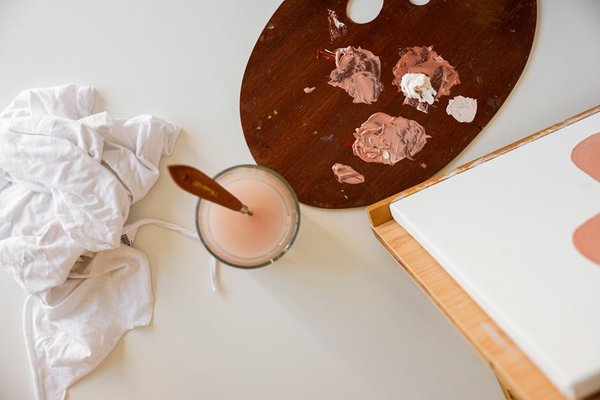
How to make brown colour paint from primary colours?
To make brown colour paint from primary colours, combine a medium red (#C74336) and yellow (#F4C542) first, then add blue (#315EA8) gradually until the orange cast near #D77727 settles into brown. A useful test ratio is 2 parts yellow, 1 part red, and 1/2 part blue, then adjust in small increments.
Brown is easiest to control when you build it from a repeatable sequence instead of mixing all three primaries at random. Measured adjustments make the result easier to reproduce.
What primary colors make the cleanest starting brown?
Start with a medium red close to #C74336, a saturated yellow close to #F4C542, and a medium blue close to #315EA8. Those three give you enough strength to reach a useful brown without forcing large corrections from an overly dark or pale starting mix.
The three primaries do not need equal amounts. Combining #C74336 and #F4C542 first gives a mixture near #D77727; adding #315EA8 then pulls it toward brown in a controlled way.
If you are also mapping out which colours make brown paint, begin with two primaries, then use the third as the balancing color. This is easier to repeat than correcting a three-way mixture after the fact.
For a deep finished reference, Sherwin-Williams Rookwood Dark Brown SW 2808 is #5F4D43. Use it as a checkpoint for judging whether your mix reads as a balanced dark brown.
#5F4D43 · Sherwin-Williams Rookwood Dark Brown SW 2808
In north-facing light it reads cooler and slightly grayer; south-facing light brings forward more of its red-brown character. Use it for roughly 20 percent of a room on an accent wall, built-ins, or millwork rather than covering every surface.
How should you balance red, yellow, and blue?
Use a starting ratio of 2 parts #F4C542, 1 part #C74336, and 1/2 part #315EA8, then make corrections in tiny measured amounts. The exact result will vary with pigment strength, so treat the ratio as a repeatable starting point rather than a universal factory formula.
For a test batch, use 2 tablespoons #F4C542, 1 tablespoon #C74336, and up to 1/2 tablespoon #315EA8. Add the final component gradually because it can change the mixture quickly.
A repeatable mixing sequence
- Measure the first primary: Put 2 tablespoons of #F4C542 into a clean cup.
- Add the second primary: Mix in 1 tablespoon of #C74336 until the batch is uniform.
- Introduce the balancing primary: Add #315EA8 in 1 teaspoon portions, stirring fully after each addition until the mixture reaches brown.
- Make fine corrections: Once the mix is close, switch to 1/4 teaspoon adjustments.
- Paint a test patch: Brush it onto a primed white card or wall sample and let it dry fully.
- Record the formula: Write down every amount used so you can scale the same ratio later.
This is the clearest answer to how do you make brown paint with primary colours: measure, neutralize gradually, let the sample dry, and keep a written recipe. If you skip the measuring step, even a good first batch can be difficult to reproduce for a second coat.
How do you lighten the mix without losing its brown character?
Lighten the mixture by adding the same paint line’s untinted white base in 5 percent increments, then restore balance with very small additions of #C74336 and #F4C542 if the result becomes too gray. Stop and dry-test after each change, because wet paint can mislead you about the final value.
For a medium-light reference, Sherwin-Williams Nearly Brown SW 9093 is #A88E76. It shows the point where a brown can become noticeably lighter while still reading as brown rather than moving all the way toward a pale cream-like value.
#A88E76 · Sherwin-Williams Nearly Brown SW 9093
North-facing light makes this read a little grayer, while south-facing light brings out more of its tan-brown cast. On walls it can cover roughly 60 percent of the room, leaving the remaining area to ceiling, trim, flooring, and furnishings.
In a 4-tablespoon test batch, add about 1 teaspoon of untinted white base, mix thoroughly, and check the dried sample. If it becomes too washed out, add 1/8 teaspoon each of #C74336 and #F4C542 before testing again.
For a paler formula, how to make light brown colour paint treats the white base as part of the recipe. For more depth, how to make dark brown colour paint starts from a measured brown base instead of relying on a large dose of #000000.
For how to make brown paint from primary colours, lightening works best in stages, with a dry sample between each adjustment.
How do you fix a brown that turns green, orange, or purple?
Correct the cast by adding the primary that opposes the color you can see, and make the adjustment in tiny amounts. For a 4-tablespoon test batch, start with only 1/4 teaspoon of the correcting primary, stir completely, and dry-test before adding more.
- If the mixture looks green, around #667348: add #C74336 in 1/4 teaspoon increments. Stop as soon as the green cast disappears; continuing can push the mixture too far toward a red-brown result.
- If the mixture looks orange, around #B66A2C: add #315EA8 in 1/4 teaspoon increments. Mix fully after each addition because the blue component can neutralize the orange cast quickly.
- If the mixture looks purple, around #74566E: add #F4C542 in 1/4 teaspoon increments. The yellow component reduces the purple cast and returns the mix toward a balanced brown.
If one correction creates another cast, stop and remake a 4-tablespoon batch from the recorded base ratio. Repeated corrections quickly become hard to reproduce.
Judge the mix only after it dries. Put the test on the wall or a movable primed card and check it in both morning and afternoon light before scaling up.
- Wall test patch 24 x 24 in
- Gap between test patches 6 in
- Close viewing distance 6 ft
- Across-room viewing distance 12 ft
- Swatch center height 60 in from the floor
When does mixing your own brown paint not work well?
Hand-mixing is a poor choice when you need several gallons to look identical across a whole room. A 12 x 15 ft room with 8 ft ceilings can require multiple gallons once you account for two coats, doors, windows, and surface absorption; if batch two is even slightly different, the change can show at a corner or wall break. It also does not work well when the paints come from different product lines, have different sheens, or use incompatible formulations.
It is also easy to overestimate what a tiny sample proves. A perfectly mixed 24 x 24 in patch can look convincing in a photograph but still feel much darker once it covers four walls. North-facing rooms can pull a deep mix like #5F4D43 cooler and grayer, while south-facing rooms reveal more of its red-brown side. For an entire room, develop the color by hand if you enjoy the process, then have one consistent formula mixed for the final job.
Frequently asked questions
Can I mix wall paints from different brands to make brown?
Many water-based paints will combine, but different binders or sheen levels may dry and wear differently. For a wall project, keep test paints within the same product line and use the homemade mix mainly to establish the target color.
Can I make brown without using all three primary colors?
Yes, two opposing pigments can sometimes produce brown, but the result depends heavily on the exact pigments. Three primaries give you a clearer correction path because each shift can be adjusted with a measured amount of the missing primary.
Should I add black to make the brown darker?
Use #000000 sparingly because it lowers value quickly and can flatten the mix. Deepen the existing primary recipe first, then use only a tiny amount of #000000 if the dried sample still needs more depth.
Why does my brown look different after it dries?
Paint changes as the liquid carrier evaporates and the film settles, so the wet mixture is not the final reference. Let the test patch dry fully, then view it under the room’s actual daylight and electric lighting before adjusting the recipe.
Can a paint store match my homemade brown sample?
Many U.S. paint retailers can scan a solid, dry sample and create a close match in one of their paint lines. Bring a flat, evenly coated sample large enough for the store’s scanner and keep the matched formula on the label for future touch-ups.
The most reliable way to learn how to make brown colour paint from primary colours is to work in small measured batches, dry-test every correction, and record the formula that succeeds. Use the hand-mixed sample to choose the exact brown you want, then scale carefully or have the final room paint matched into one consistent product.