
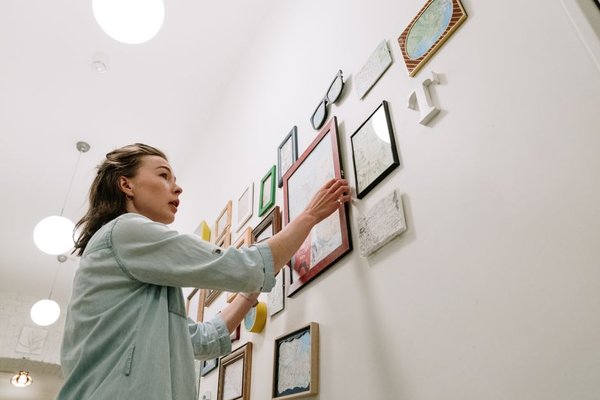
How to create a gallery wall that feels balanced?
To learn how to create a gallery wall, start with one anchor piece, build outward with smaller frames, keep the gaps consistent, and make the arrangement relate to the furniture below it. Test the full composition with paper templates first, then hang from the center outward instead of placing pieces randomly.
A balanced gallery wall does not need identical artwork or matching frames. It needs a clear visual center, repeatable spacing, and an overall shape that looks intentional from across the room.
How to create a gallery wall?
Start by deciding how much wall area the arrangement should occupy, then choose one piece to act as the visual anchor. Build the rest around that anchor while keeping the outer shape and spacing controlled.
Gather the picture frames, art prints, photo prints, and personal pieces you actually want to display. Measure each item including its frame. If you still need frames, Best Gallery Wall Frames: Sets, Sizes and Finishes Compared can help you choose sizes and finishes that work together without forcing every piece to match.
Use this step-by-step layout method
- Measure the usable wall area: Note the width available above the sofa, console, bed, or other furniture, plus switches, vents, lamps, and door swings.
- Choose the anchor piece: Start with the largest or most visually dominant artwork. It can sit near the center without being mathematically centered in the final group.
- Set the overall width: Over furniture, aim for roughly two-thirds to three-quarters of the furniture width. A 72-inch console can usually support a grouping about 48 to 54 inches wide.
- Build outward on the floor: Place the anchor first, add medium pieces, then use smaller items to close awkward gaps.
- Make paper templates: Trace each frame onto kraft paper or other paper templates, cut them out, and label them.
- Test the layout on the wall: Tape the templates up with a removable tape suitable for the paint finish, then step back 8 to 10 feet and check the whole shape.
- Mark hanging points: Transfer each frame’s hardware position to its template before installing hooks or fasteners. For the hanging sequence, use how to hang a gallery wall.
If the artwork includes several print formats, check wall art print sizes before finalizing the layout. A small print with a wide mat can carry more visual weight than its image dimensions suggest.
How to arrange a gallery wall?
Arrange a gallery wall by treating the whole group as one large shape rather than a set of separate frames. The strongest layouts usually have an anchor, a few repeated alignments, and enough variation to avoid looking accidental.
Distribute visual weight instead of placing every large piece on one side. If the anchor sits left of center, balance it with two or three smaller pieces on the opposite side. Watch the empty space between frames as carefully as the artwork itself because inconsistent gaps often make the layout feel wrong.
- Place the largest piece first.
- Add medium frames before the smallest ones.
- Repeat one or two frame finishes for continuity.
- Avoid a single unusually narrow or wide gap.
- Photograph the floor layout before moving anything.
For a more controlled setup, a gallery wall planning checklist helps you record frame dimensions, hanging hardware, template labels, and final spacing before installation.
How far apart should gallery wall frames be?
Keep most gallery wall frames about 2 to 3 inches apart. Consistency matters more than choosing one exact number, so select a gap that suits the frame sizes and repeat it through the arrangement.
A 2-inch gap usually keeps smaller frames visually connected, while 3 inches gives larger pieces more breathing room without separating the group. Measure from the outside edge of one frame to the outside edge of the next, not from the image or mat.
Cut a 2- or 3-inch spacer from cardboard and use it while positioning templates. That is faster and more reliable than measuring every gap separately.
Should a gallery wall be centered on the wall or furniture?
If the gallery wall sits above a sofa, console, bed, or sideboard, center the arrangement on the furniture rather than the entire wall. The furniture and artwork read as one composition, so their visual centers should relate.
For a gallery wall on an otherwise empty wall, use the usable wall area as the reference. Aim for the visual center of the arrangement to sit roughly 57 to 60 inches from the floor, then adjust slightly for the room and the size of the group.
Above furniture, keep the bottom of the grouping about 6 to 8 inches above the top surface or back. A much larger gap can make the artwork look disconnected, while a very small gap can make the wall feel crowded.
When does a gallery wall not work well?
A gallery wall is a poor choice when the room already has too many small visual elements, the available wall is broken by doors or tall storage, or the only workable position forces frames into a narrow strip. The oversized, perfectly layered arrangements seen in styled photographs often fail in real rooms because they depend on a wide empty wall, controlled furniture placement, and almost no daily clutter competing with the art.
It can also be the wrong project in a rental where the lease does not allow multiple wall holes. Removable products may help with lightweight pieces, but stay within the manufacturer’s stated weight limits and do not assume every painted surface will release cleanly. Heavy glazed frames need secure hardware, and renters should not improvise anchors that breach tenancy terms. In homes with young children or active pets, avoid glass-fronted frames low enough to be hit or pulled. If those limits remove most of the useful wall area, one larger piece is more practical than forcing a gallery arrangement into the room.
Frequently asked questions
How many pieces should a gallery wall have?
There is no fixed number, but three to nine pieces is manageable for many home layouts. Let the available wall area and frame dimensions decide rather than adding pieces simply to fill space.
Can a gallery wall include photos and art together?
Yes. Photo prints, illustrations, paintings, and personal pieces can share one arrangement if the spacing and overall scale tie them together. Repeating a few frame sizes or finishes helps the mix look intentional.
What size should the anchor piece be?
The anchor should usually be one of the largest pieces in the arrangement. It only needs enough visual weight to organize the smaller frames around it.
Do all gallery wall frames need to match?
No. Mixed finishes can work well when some sizes, profiles, or materials repeat. Avoid too many one-off choices that appear nowhere else in the group.
How can I plan a gallery wall without making extra holes?
Trace every frame onto paper, tape the templates to the wall, and move them until the spacing and outline feel right. Mark the exact hanging point on each template before installing hardware.
The easiest way to create a gallery wall that looks balanced is to make the decisions before anything is permanently hung. Choose the anchor, control the overall width, repeat the spacing, and test the composition with templates so the finished wall feels connected to the room.