
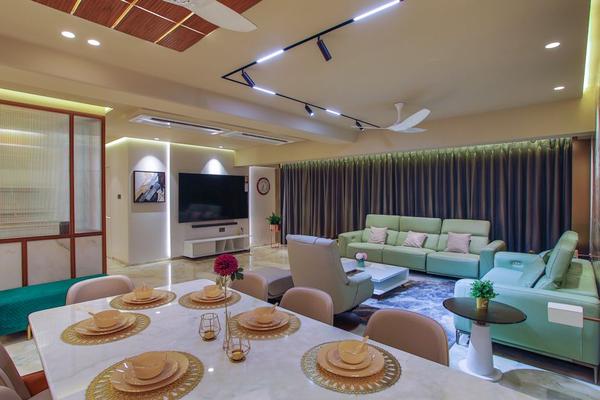
How to decorate a living room on a budget?
To learn how to decorate a living room on a budget, set one total spending cap, fix the layout before buying anything, spend first on seating and the rug, then use paint, curtains, lighting, and a few larger accessories to finish the room. Measure every item so low-cost purchases still look intentional.
A budget room works best when money follows daily use. Start with function, scale, and color proportions, then buy only pieces that solve a visible gap.
How to decorate a living room on a budget?
Decorate in a fixed order: budget, measurements, palette, major furniture, textiles, lighting, then accessories. That sequence protects the money needed for a usable sofa, correctly sized rug, and window treatment.
Use this 7-step budget makeover plan
- Set one spending cap: On a $500 makeover, split $200 for seating or furniture fixes, $100 for a rug, $75 for window treatments, $75 for lighting and wall decor, and $50 for paint or supplies.
- Measure the room and lock the layout: Record wall lengths, window widths, door swings, and traffic paths. Keep main walkways 30 to 36 inches wide and leave 16 to 18 inches between the sofa and coffee table. Tape furniture footprints before ordering.
- Choose a specific three-color plan: Use about 60% Sherwin-Williams Alabaster SW 7008 on walls, 30% #C9C2B8 across the area rug and larger textiles, and 10% Sherwin-Williams Naval SW 6244 in pillows, art, or one small painted piece. North-facing rooms pull colors cooler and grayer, so if Alabaster feels flat, use Sherwin-Williams Creamy SW 7012 for the 60% field. South-facing rooms add warmth, so keep the 30% textile zone nearer #C4BDB4 instead of #D1C6B8.
- Keep the largest usable pieces: Replacing a sofa can consume the budget. If its frame is sound, improve the room with a better arrangement, washable covers sized to the cushions, and one or two new pillows.
- Fix the rug and windows: In many standard living rooms, an 8-by-10-foot rug can hold the front legs of the main seating. Hang curtains with the rod 4 to 6 inches above the trim and, when wall space allows, 6 to 12 inches beyond each side. Let panels finish about 1/2 inch above the floor.
- Improve lighting before adding decor: If one ceiling fixture does all the work, add a floor lamp beside the sofa or a table lamp on a side surface. Using 2700K bulbs in visible lamps keeps the light temperature consistent.
- Finish with fewer, larger accents: Use one substantial piece of wall art and a small group of objects instead of covering every surface. For measured purchases within a fixed cap, use Best Affordable Living Room Decor Under $100 before checking out.
How to furnish a living room on a budget?
Furnish from the largest functional need down, not from the cheapest accessory up. Prioritize seating, one reachable surface, a correctly scaled rug, window coverage, and lighting before decorative extras.
- Sofa: A 72- to 84-inch sofa fits many small to medium living rooms. Keep about 30 to 36 inches clear on a main traffic route.
- Coffee table: Aim for roughly two-thirds the sofa length, about 16 to 18 inches high, with a 16- to 18-inch gap to the seat edge.
- Area rug: Size it to the seating group, with at least the front legs of the main seating on it.
- Window coverage: Measure from the planned rod height to the floor, not just the glass, before buying panels.
Search IKEA, Target, Walmart, HomeGoods, and local resale stores from a written list. Use where to buy affordable home decor to narrow the store type to the item you actually need.
How to update living room on a budget?
Update the parts that occupy the most visual area before replacing small decor. Rearranging furniture, correcting the rug, improving the window line, and repainting a worn wall usually have more impact than small accessories.
Remove items with no job, then reposition seating around the room’s focal point. If paint is allowed, refresh the dominant wall field with Sherwin-Williams Alabaster SW 7008. In a rental where painting is prohibited, keep the existing wall finish as the 60% field and use the 30% and 10% color proportions in removable textiles and art.
Straighten the curtain line, center the rug on the seating group, secure exposed cords safely, and use matching 2700K bulbs in visible lamps. Before buying decor, review affordable living room decor and fill only a measured gap.
What should I change first in a living room?
Change the layout first because it costs nothing and shows whether the room really needs more furniture. After traffic paths and seating positions work, fix the largest scale problem, often the rug, window treatment, or wall finish.
Keep 30 to 36 inches clear on main walkways and the coffee table 16 to 18 inches from the sofa. Center the rug on the seating group, not the room itself. If the room still feels unfinished, use cheap living room ideas to find small changes that support the layout.
When does a budget living room makeover not work?
A low-cost makeover does not work when the room has a functional problem that decor cannot solve. A damaged sofa frame, unsafe wiring, active water damage, or a landlord restriction needs attention first; electrical, structural, or water-related work belongs with the appropriate qualified professional or property owner.
Some ideas only work in photographs. A room that lacks enough storage will not improve through accessories. A tiny rug floating in the center can look neat in a tight crop but usually leaves the seating disconnected. Long curtain puddles photograph well yet collect dust and are impractical around pets, young children, or robot vacuums. Replacing a useful sofa with two sculptural chairs may create an attractive image while reducing everyday seating. Sparse open shelving can also look polished online but fail if the room needs closed storage. If the budget is extremely tight, skip styling purchases and fix layout, cleaning, lighting, and placement first.
Frequently asked questions
How much should I spend on a budget living room makeover?
Set a total you can spend without borrowing, then divide it before shopping. $300 to $500 can make a visible difference if the room already has usable seating and you focus on its largest gaps.
Can I decorate a living room cheaply without painting?
Yes. Treat the existing walls as the 60% field, then create the remaining 30% and 10% through an area rug, curtains, pillows, art, and removable accessories in exact repeated colors.
What size rug works best in a living room?
Choose from the furniture footprint, not the empty floor. An 8-by-10-foot rug works in many standard seating groups, but measure first and aim to place at least the front legs of the main seating on it.
How high should living room curtains be hung?
Place the rod about 4 to 6 inches above the window trim and, when space allows, 6 to 12 inches beyond each side. Measure so the panel hem finishes about 1/2 inch above the floor.
Should I buy all the living room decor at once?
No. Buy the functional pieces first, live with the layout for a few days, then add only what the room still lacks. This helps prevent duplicate accessories and unfocused spending.
Learning how to decorate a living room on a budget is mostly about spending in the right order. Measure first, protect the money for the biggest functional and visual gaps, and use exact color, scale, and spacing decisions so inexpensive pieces look deliberate.