
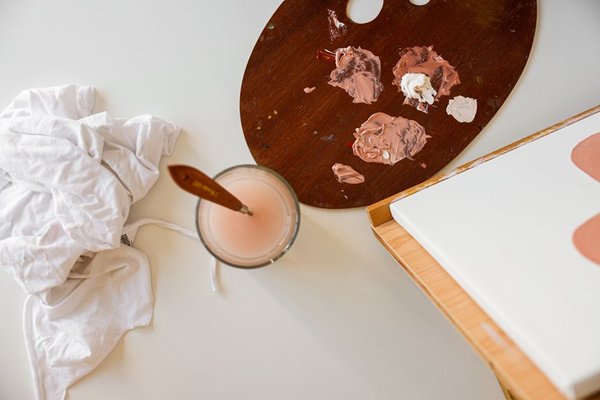
How to make brown paint from primary colours at home?
To learn how to make brown paint from primary colours, mix two parts yellow with two parts red, then stir in up to one part blue gradually. Record the exact amounts, test a brushstroke, and allow it to dry before adjusting. The proportions are a starting recipe, not a guaranteed result across different paint brands.
A good brown mixture is repeatable because every addition is measured. These instructions use compatible water-based artist paints for test pieces; large interior walls need a purpose-made coating, not an improvised craft-paint batch.
What order should you mix the primary colors in?
Blend red and yellow first to make an orange base, then add blue little by little. Because pigments vary in strength, your final blue amount may be smaller than the nominal one-part allowance.
Follow these numbered mixing steps
- Set up your palette: Gather compatible red, yellow, and blue paints, a clean mixing knife, one measuring spoon, white test paper, and a notebook. Keep old pigment out of the containers.
- Measure the yellow: Put two level spoonfuls onto a clean palette. Choose a single spoon size and use it throughout the sample so every part represents the same volume.
- Add the red: Measure two identical spoonfuls and fold them into the yellow. Continue mixing until there are no visible streaks; incomplete mixing makes later corrections difficult to judge.
- Add blue cautiously: Mix in half a spoonful first. Introduce the rest in smaller increments, stirring thoroughly between additions, and stop as soon as the dried color looks right.
- Make a labeled test: Brush a thin stroke onto a white sample board and write down the pigment amounts. A phone photo can help track progress but cannot replace the physical sample.
- Check after drying: Wait for the paint manufacturer’s stated drying period. Compare the dry stroke under ordinary room lighting, then either save the recipe or make one measured correction.
Do not assume a different manufacturer’s red, yellow, and blue will behave identically. Two paints with the same everyday color name can contain different pigments and reach different browns at the same ratio.
For the broader reasoning behind colours make brown paint, see the pillar guide. People also ask what two colours make brown paint; complementary pigment pairs can produce brown, but the method here intentionally uses all three traditional primaries.
How much of each primary color should you begin with?
Start with two parts yellow, two parts red, and a maximum of one part blue. If one part equals a quarter-teaspoon, measure half a teaspoon of yellow, half a teaspoon of red, and reserve a quarter-teaspoon of blue for gradual additions.
Keep the baseline useful
Use a clean shallow container, and record not only the spoon size but also the paint brand and product line. Do not dilute the sample with extra water just to make it look lighter: excessive water changes opacity and may weaken the finish. Follow the product’s dilution directions.
- Save a control: Reserve a dab of the original mixture before each correction so you can compare dry results.
- Note fractions: Write down every eighth-part or quarter-part addition immediately, rather than relying on memory.
- Test the same way: Apply each stroke at a consistent thickness on the same kind of surface.
The phrase how to make brown colour paint from primary colours sounds like it should have a single fixed answer. In practice, pigment strength controls the result, so the written recipe and final dry swatch matter more than the first wet mixture.
How do you adjust the brown after the first mix?
Change only one pigment per test and use less than one original part each time. Stir well, make a new labeled brushstroke, and let it dry before deciding whether another correction is needed.
This table separates useful small corrections from moves likely to make the mixture harder to recover.
| Appearance of brown sample | Measured change to try | Change to avoid |
|---|---|---|
| Orange rather than brown | Add a small amount of blue | Pouring in a full blue part |
| Greenish cast | Add a trace of red | Adding more yellow first |
| Violet or reddish cast | Add a trace of yellow | Adding blue without testing |
| Almost black | Restart with less blue | Making several large corrections |
| Looks different once dry | Use the dried stroke as reference | Judging only the wet palette |
Do not confuse mixing a useful brown for a picture frame with making interior wall paint. Wall coatings must cover evenly, adhere to the surface, and withstand cleaning. For a room, take your dry reference to a paint retailer that can prepare an appropriate interior product.
For a specific light wall-color comparison, consider Benjamin Moore Pale Oak, represented here by the planning hex #D8CFC4. A screen code cannot guarantee the final coating color, so get a manufacturer sample rather than asking the store to mix from a phone alone.
#D8CFC4 · Benjamin Moore Pale Oak
It usually looks warmer in south-facing daylight and can turn noticeably grayer in north-facing light. After testing a real sample, it could cover about 60 percent of a room’s visible surfaces, chiefly walls and ceiling.
If the dried color needs further changes, how to make light brown colour paint covers lighter results, while how to make dark brown colour paint discusses darker mixtures. Avoid treating repeated blue additions as the only route to a deeper shade.
How do you scale a successful sample up for a larger batch?
Multiply every final ingredient amount by the same factor, including the corrections you made after the initial recipe. Make a second sample of the enlarged mix before applying it to your finished piece.
Scale the final recipe, not the original estimate
Suppose the successful sample contains two parts yellow, two parts red, and three-quarters of a part blue. Four times that recipe calls for eight parts yellow, eight parts red, and three parts blue. If you instead use four parts blue, you have changed the successful ratio. Scrape the container sides and stir thoroughly before testing.
Estimate the painted area before making extra material. A board measuring 12 by 12 inches has 1 square foot of surface; two matching boards require about twice the paint at the same coat thickness. Allow for waste and use the product’s stated coverage for any larger project.
- Test board width 12 in
- Test board height 12 in
- Second board width 12 in
- Spacing between wall samples 12 in
- Area of each square test 1 sq ft
View one sample near the window and another farther into the room. North-facing daylight often makes the same paint appear cooler and grayer, while south-facing daylight can emphasize warmer notes. Revisit the boards after sunset under the lamps you actually use.
For a rental, use movable test boards and seek permission before repainting. Label any leftover mixture with its exact product and ratio, and keep it in a suitable sealed container according to the manufacturer’s storage instructions.
When does mixing your own brown paint not work well?
Hand-mixed brown is a poor solution for covering an entire room if you cannot make enough paint in one controlled batch. Even a careful small recipe can shift when you change containers, pigment brands, or tools. Uneven batches leave obvious patches on a broad wall, especially when sunlight falls across it at an angle.
Small north-facing rooms are another reality check. A shade that looks attractive in a bright promotional photograph can read distinctly grayer on a full wall. Styled images often hide patchy coverage, scuffed corners, and the difference between daylight and evening lamps. A convincing photograph is not evidence that a homemade mix will perform well in your space.
If money is tight, repeated unsuccessful samples can cost more than buying the right manufacturer sample in the first place. Painting a rental without approval may create repair costs. In homes with pets or young children, select an interior finish suitable for cleaning and follow its ventilation and curing instructions. Craft acrylic is not a safe shortcut to a durable wall coating merely because its color looks acceptable.
Frequently asked questions
Can acrylic primary colors be mixed into brown?
Yes. Mix compatible red and yellow acrylics first, then introduce blue gradually and make a dry sample. Actual pigment formulations determine how much blue you need.
Do you need black paint for this recipe?
No. All three traditional primary paint colors can create brown without adding black. Too much blue may make the batch appear nearly black anyway, so measure carefully.
Will water lighten a dark brown mixture?
Water often makes paint more transparent rather than reliably lighter and more opaque. Adding too much may affect durability, so check the product instructions instead of diluting at random.
Can a hex code tell a paint store the exact recipe?
No. Hex codes describe digital colors, not fixed physical pigment ratios. Ask the store to compare a real paint sample under appropriate lighting for a closer match.
Why does my brown change appearance near windows?
Direction and intensity of daylight alter how a surface looks, as do nearby furnishings and lamps. Check the dried sample in the intended room at several times of day before choosing it.
Start with a measured red-and-yellow base, add blue cautiously, and judge only a fully dried sample. Preserve the exact successful recipe for small projects, and have a suitable interior coating professionally matched when the job involves a large wall.