
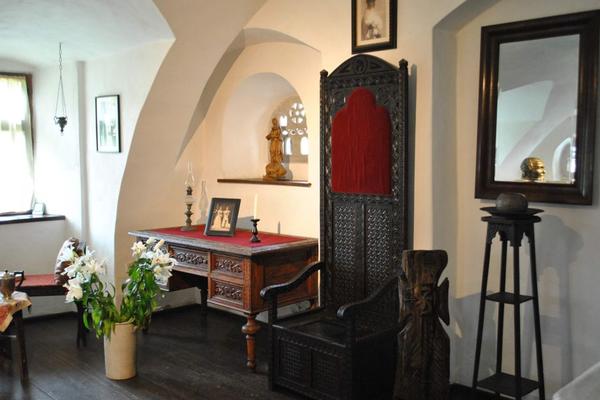
What is spanish colonial style interior design?
Spanish colonial style interior design combines substantial architectural forms, plaster-like walls, exposed or dark-stained wood, clay tile, iron details, and restrained furnishings. Start with the room’s permanent materials, choose a measured paint palette, and leave space around heavy pieces. Arches and ornament should support the structure rather than compete with it.
A convincing room does not need a complete renovation or a colonial-era house. It needs order: solid surfaces first, furniture with weight second, and tactile details that look useful rather than staged.
Which details define Spanish Colonial interiors?
The clearest signs are deep openings, rounded arches, plaster surfaces, timber, fired-clay flooring, and wrought iron. In Spanish Colonial interiors, these usually read as part of the building, not decorations attached afterward. You can suggest that character without pretending modern drywall is historic masonry.
Definition: Spanish Colonial interior style draws on the architecture of Spanish-era buildings in the Americas, including locally shaped traditions of adobe, masonry, plaster, timber, tile, and courtyards. Modern interpretations borrow recognizable elements, but the historical buildings differed by region and available materials.
Start with the building
Look at your floor, doorways, ceiling height, fireplace, and window depth before shopping. If you already have clay tile or a substantial wood beam, keep it visible. A collection of decorative objects cannot compensate for furniture blocking the room’s strongest architectural detail.
Keep the signatures recognizable
- Walls: Low-glare surfaces with subtle variation keep the focus on architectural shapes.
- Timber: One substantial dining table or cabinet provides enough visual weight.
- Clay: Tile, pottery, and planters repeat a tactile material without adding more patterns.
- Iron: One functional lantern-style fixture or straightforward curtain rod supplies a crisp line.
What colors work with terracotta tile and dark wood?
Keep most painted area light, make a smaller zone more grounded, and reserve near-black paint for a small accent. Terracotta tile and dark-stained wood already carry strong visual weight. Test paint beside the actual floor rather than against a store display.
Three US paint colors to sample
Sherwin-Williams Alabaster SW 7008, represented digitally by #EDEAE0, can cover the main walls and broad ceiling areas. In a typical scheme, allocate about 60 percent of visible surfaces to this primary painted backdrop.
#EDEAE0 · Sherwin-Williams Alabaster SW 7008
North-facing daylight can make it appear cooler and less creamy; south-facing sun draws out more warmth. Use across about 60 percent of the visible room.
For a recessed wall or another limited area, Sherwin-Williams Accessible Beige SW 7036, digitally represented by #D1C7B8, provides depth. Keep it to roughly 15 percent of visible surfaces so a narrow room remains open-looking.
#D1C7B8 · Sherwin-Williams Accessible Beige SW 7036
It can read grayer in north-facing light and more noticeably beige in southern sun. Reserve it for approximately 15 percent of visible surfaces.
For a painted metal detail or small freestanding cabinet, Sherwin-Williams Iron Ore SW 7069, digitally represented by #434341, relates to existing wrought iron. Limit this accent paint to roughly 5 percent of visible surfaces.
#434341 · Sherwin-Williams Iron Ore SW 7069
It reads more charcoal under cool northern light and shows slightly more warmth in southern sun. Keep accents near 5 percent of the room.
Leave the remaining 20 percent visually occupied by exposed wood, tile, ceramics, and fabric; those percentages are planning guides rather than exact coverage calculations. A north-facing room can make the entire scheme seem cooler and flatter, while a south-facing room intensifies apparent warmth. Digital hex references do not replace physical samples: check large painted boards at different hours and with your evening lamps.
Which furniture and textiles suit Spanish Colonial rooms?
Choose solid-looking pieces with simple outlines, then soften them with fabric that survives daily use. A carved cabinet or substantial wood table can anchor the room without making every chair ornate. Leave flooring visible around rugs so architectural surfaces still matter.
Fit before carving
In a 12 x 15 ft living room, begin with a sofa about 78 to 84 in wide, a coffee table around 42 to 48 in long, and one compact chair. Check door swings and the route across the room before ordering a deep carved bench. Editorial photographs often show furniture in rooms much larger than ordinary homes.
- Sofa to coffee table 16 to 18 in
- Clear main walkway 30 in minimum
- Rug beneath sofa front legs 8 x 10 ft for a 12 x 15 ft room
- Dining chair pullback 36 in from table edge to wall
- Artwork center above console 57 in above the floor
Use textiles for relief and daily comfort
Try washable cotton slipcovers, a tightly woven rug, leather on a frequently used chair, and baskets that actually hold throws. One striped cushion or runner brings pattern without clashing with tile joints and wood carving. Keep dining rugs low-pile so chairs slide and crumbs do not settle deeply.
For the wider family of furnishing approaches, explore style interior design. The material-led approach also relates to spanish style interior design and mediterranean style interior design, although those labels do not describe identical architectural histories.
How do arches, ironwork, and carved wood affect the rest of the scheme?
An arch sets a strong outline, iron adds a dark line, and carving creates small shadows. Each needs calmer neighboring surfaces, so repeat them sparingly. An existing architectural opening should take priority over a decorative object shaped like one.
Choose interventions that suit the house
Permanent construction and movable furnishings require different budgets and permissions. Use this comparison to decide how much physical change the room actually needs.
| Room element | Permanent architectural approach | Reversible furnishing approach |
|---|---|---|
| Door opening | Professionally designed arched opening | Curved-top mirror near an existing doorway |
| Ceiling | Retained, assessed structural timber | Substantial wood furniture beneath plain ceiling |
| Iron detail | Hardwired fixture installed by a licensed electrician | Portable iron-look lamp |
| Wall finish | Compatible plaster system for the substrate | Woven wall art on approved hooks |
| Clay material | Professionally prepared tiled floor | Ceramic planters and tableware |
Never cut an arch into a load-bearing wall or add heavy overhead timber without a qualified structural professional. Hardwired lighting requires a licensed electrician and compliance with applicable local rules. A lightweight false arch may look convincing in a cropped photograph but awkward at eye level when its depth does not suit the wall.
Judge carved furniture by its silhouette before the ornament. One detailed cabinet next to a plain sofa often feels deliberate; repeated carved chair backs, picture frames, and console legs compete. Avoid fake beams in a low-ceilinged room, where they reduce the sense of height without adding authentic structure.
The label Spanish Colonial decor is sometimes applied to a room containing only lanterns and pottery. Objects alone do not define it. Understanding the context of colonial Spanish style helps you choose practical furniture without turning a living room into a themed display.
When does a Spanish Colonial look fail in a small room or rental?
It fails when heavy furniture, fake arches, and decorative ironwork leave no space to move. A 10 x 11 ft apartment living room will not become a courtyard house by adding a massive carved coffee table and several lanterns. Those arrangements can look powerful in a wide-angle photograph, then feel cramped as soon as someone walks around the sofa.
North-facing rooms also expose bad paint decisions. A sample that looks inviting under store lighting may appear flat beside dark existing flooring. Test large samples throughout the day before coating every wall. Low ceilings present another hard limit: imitation beams can make the room feel shorter without supplying any architectural credibility.
In rentals, do not glue tile over existing floors, carve openings, plaster walls, or swap hardwired fixtures without written permission. Removable furnishings and portable lamps are enough. With pets or young children, skip unstable pottery on pedestals, sharp-edged chests in walkways, and precious high-maintenance fabrics. Historic-looking is not an excuse for impractical.
Frequently asked questions
Can I use the style in a modern suburban house?
Yes. Keep the house’s architecture honest and add one wood furniture anchor, ceramics, and considered textiles. It can feel Spanish-influenced without pretending to be centuries old.
Do I need expensive antique furniture?
No. Antiques can add craftsmanship, but comfortable contemporary seating is fine when the proportions suit the space. Prioritize build quality and everyday use over provenance.
What should I buy first for a subtle Spanish Colonial look?
Choose one useful piece, such as a substantial wood side table or ceramic planter, that complements something already in the room. Several small themed accessories usually make less impact than one purposeful item.
Should a rug cover all of my clay tile floor?
Not if the tile is a defining element you want to retain. Leave a visible border of flooring and choose a rug that allows doors and dining chairs to move freely.
Can I use contemporary lighting with traditional wood furniture?
Yes. A restrained fixture can work when its scale suits the table or seating group. Choose functional illumination and safe installation rather than a decorative lantern that is too dim.
Keep the strongest existing material visible, provide a measured paint backdrop, and select furniture that fits the floor plan. Spanish Colonial-inspired rooms work best through proportion, usefulness, and restraint rather than a collection of themed objects.