
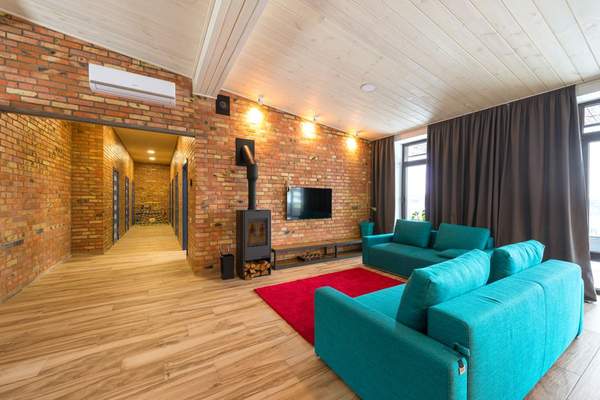
What is the best living room rug layout?
The best living room rug layout keeps the seating group visually connected without blocking circulation. In most rooms, place at least the front legs of the sofa and chairs on the rug, keep 16 to 18 inches between the sofa and coffee table, and leave a consistent border of exposed flooring around the rug.
A rug should connect the seating area rather than float under the coffee table. Start with the furniture footprint, then choose a size that connects the sofa, chairs, tables, and walking paths.
How to plan a living room rug layout step by step
- Measure the seating zone: Measure the full width and depth of the sofa-and-chair arrangement, not just the open floor between pieces.
- Mark the walking paths: Protect routes to doors, hallways, and adjacent rooms before deciding where the rug edges will fall.
- Choose the furniture connection: Decide whether front legs or all legs will sit on the rug, then size the rug around that choice.
- Center the rug on the seating group: Use the sofa and main chairs as the visual center instead of automatically centering the rug on the room.
- Check coffee-table clearance: Keep the coffee table fully on the rug and leave 16 to 18 inches from the sofa.
- Tape the outline before buying: Mark the proposed rug edges with painter’s tape so you can test circulation and furniture balance at full scale.
If you are choosing a new living room rug, measure after the furniture is in its normal position. Those dimensions are more useful than measuring an empty room and guessing where the seating will sit.
Where should a rug start in relation to a living room sofa?
For most sofa layouts, the rug should begin far enough under the sofa for the front legs to rest securely on it. An overlap of about 6 to 12 inches under the sofa front usually looks intentional and prevents the rug from appearing detached from the seating.
Keep the rug edge parallel with the sofa unless the furniture already follows an angled architectural feature. For a sofa around 84 inches wide, tape an 8 x 10 ft outline first. If the chairs or side tables fall outside that footprint, mark a 9 x 12 ft outline.
Your living room rug measurements should come from the actual furniture footprint rather than room square footage alone.
- Rug under sofa front 6 to 12 in
- Sofa to coffee table 16 to 18 in
- Clear walking path 30 in minimum
- Typical compact seating rug 8 x 10 ft
- Typical larger seating rug 9 x 12 ft
Should all furniture legs sit on the rug?
No. All furniture legs do not have to sit on the rug, but the pieces should follow one consistent rule. In a typical living room, front legs on the rug is the simplest arrangement because it connects the seating without requiring an oversized rug.
For an all-legs-on layout, let the rug extend beyond the outer furniture legs so chairs can move without immediately sliding off the edge. Avoid mixing unrelated placements within one seating group; consistency matters when placing rugs in living room arrangements.
How do you center a rug in an open-plan living room?
Center the rug on the seating zone, not automatically on the entire open-plan space. It should visually belong to the sofa-and-chair group even when the kitchen, dining area, or walkway extends farther on one side.
Use the main sofa centerline as your starting point. If two sofas face each other, center the rug between them; in an asymmetrical room, let the furniture arrangement define the rectangle.
Keep at least a 30-inch clear path behind the sofa or between zones. Do not push the rug into circulation space simply to center it within the larger room.
For a strongly patterned rug, #D8CFC4 paired with Benjamin Moore Pale Oak gives the surrounding walls a specific, repeatable reference instead of an undefined neutral.
#D8CFC4 · Benjamin Moore Pale Oak
Reads warm and very slightly pink in south-facing light. In a north-facing room it drops noticeably grayer. Use it on walls and ceiling, roughly 60 percent of the room.
How much space should be left between the rug and walls?
Leave visible flooring around the rug so it reads as an area rug rather than poorly fitted wall-to-wall carpet. About 8 to 18 inches between the rug edge and the walls works in many living rooms while still allowing the rug to anchor the furniture.
Use the smaller end of that range in a compact room and the larger end in a spacious room, keeping the visible border reasonably consistent. Do not sacrifice the seating connection just to preserve a perfect wall border; if one edge lands closer to a wall, prioritize the furniture group.
How do you place a rug with a sectional sofa?
Place the rug so the sectional and rug read as one connected shape. At minimum, the front legs of both sectional runs should sit on the rug, and the rug should extend beyond the open end rather than stopping short inside the sectional’s footprint.
With an L-shaped sectional, use the inside corner as a reference point and keep the rug square with the sectional. A rug that is too small can make the chaise or return look detached, especially when only the coffee table sits fully on the rug.
With a large sectional, tape a 9 x 12 ft outline and check that the chaise, return, and coffee table share the rug area comfortably. See 9 x 12 rugs for living room when your seating group already occupies a large part of the floor.
How should layered rugs sit under living room furniture?
For layered rugs living room arrangements, let the lower rug define the seating zone and use the smaller top rug as an accent. Keep the upper rug centered under the coffee table or the most visible part of the group, with enough of the base rug exposed to make the layers intentional.
Use a flatter base rug and keep thick layered edges away from chair legs so furniture does not wobble or catch as it moves.
When does a large rug layout not work in a small or rental living room?
A bigger rug is not automatically better. In a very small room, forcing an 8 x 10 ft or 9 x 12 ft rug into the space can leave only a few inches of exposed floor, catch under doors, and make the rug look incorrectly sized. A smaller rug can work if it still connects the main seating pieces instead of sitting alone beneath the coffee table.
Rental rooms also create limits that styled photographs often hide. Radiators, floor vents, fixed door swings, awkward outlets, or furniture that must stay in a specific place can prevent a perfectly centered arrangement. Do not cover a floor vent or create a raised edge in a main walking path just to copy a photograph. If the ideal rug size interferes with circulation, choose the next size down and keep the front-leg rule consistent. Showroom-perfect rug choices can also be impractical with pets or young children; washable construction and a forgiving pattern may matter more than a photograph-ready floor.
How can you check the layout before ordering a rug?
Mark the proposed rug outline with painter’s tape and use the room normally before buying. Walk each route, pull chairs in and out, open nearby doors, and sit on the sofa to check whether the coffee table stays within a comfortable 16-to-18-inch reach.
For online purchases, write down the taped width and length and compare them with the retailer’s listed size; living room rug ideas only help when the arrangement fits your actual floor.
Frequently asked questions
Should a coffee table be completely on the rug?
Yes, in most layouts the coffee table should sit completely on the rug. Keeping all of its legs on one surface makes the table steadier and keeps the center of the seating group connected.
Can a round rug work in a rectangular living room?
Yes, especially with a compact or curved seating arrangement. The round rug should still be large enough to reach the front legs of the main seating pieces rather than floating only beneath a small table.
Do you need a rug pad under a living room rug?
A rug pad can reduce sliding, add cushioning, and help the rug lie flatter on hardwood or tile. Choose a pad slightly smaller than the rug so it stays hidden at the edges.
Can you use two rugs in one open-plan living space?
Yes, two rugs can define separate zones such as living and dining areas. Keep clear floor between them and align each rug with the furniture group it belongs to.
How far should a rug extend past a sofa?
A useful target is about 6 to 12 inches beyond the sofa ends when the room allows it. Keeping the rug centered on the seating group matters more than forcing an identical extension in an irregular room.
A good living room rug layout is measured from the furniture outward, not from the walls inward. Keep the seating connected, protect clear walking paths, and tape the full rug footprint on the floor before you commit to a size.