
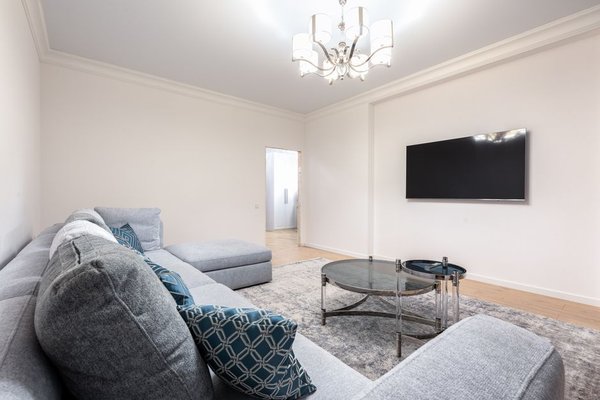
Which living room rug ideas make a room look balanced?
The best living room rug ideas start with an 8 x 10 ft or 9 x 12 ft rug that connects the seating, not a small mat under the coffee table. Put the front sofa and chair legs on it, keep walkways clear, and repeat one specific room color in the rug.
A rug should make the sofa, chairs and coffee table read as one group. Measure the floor and mark the footprint with painter’s tape before choosing a pattern.
Which living room rug ideas work with a neutral sofa?
Connect the sofa to the rug through shapes, texture or a defined border. Let the rug extend past the sofa arms so the furniture does not look stranded on a narrow island.
Eight ideas to try
- A broad border: An open center outlines the seating without competing with artwork. Aim for 8 to 12 in beyond each sofa arm.
- A repeated diamond: A geometric rhythm brings mismatched chairs together. Position both chairs with their front feet on the rug.
- A generous flatweave: Close weaving gives coffee tables stable footing. Add a nonslip pad compatible with your flooring.
- A textured solid: Ribs or loops supply interest when curtains already have patterns. View a sample in daylight.
- An offset motif: Turn the patterned end toward the emptier side. The quieter section beneath the sofa looks intentional.
- A directional stripe: Run stripes toward the focal wall to emphasize length. Align them with the sofa.
- An oversized open field: An uninterrupted center works beneath a large coffee table, while an outline frames the chairs.
- A statement graphic: For unique rugs for living room, try an enlarged motif or unusual outline. It still needs to reach the seating legs.
Before collecting more living room rugs ideas, photograph the group from the doorway. You should see the rug around the whole arrangement. The living room rug guide offers a starting point for sizing.
How can a rug add color without overwhelming the room?
Keep large surfaces consistent and let the rug carry a smaller accent. Judge swatches beside the sofa in daylight and under your lamps; online photos can distort color.
Consider Benjamin Moore Pale Oak at #D8CFC4 for walls. It provides a defined reference when shopping for the lighter parts of a pattern.
#D8CFC4 · Benjamin Moore Pale Oak
It becomes grayer in north-facing light but warmer and faintly pinker in south-facing light. Use it for roughly 60 percent of the visible room palette.
For upholstery or curtains, consider Sherwin-Williams Alabaster at #EDEAE0. Look for that reference in a rug’s background rather than assuming light fabrics match.
#EDEAE0 · Sherwin-Williams Alabaster
North-facing light makes it less creamy; southern exposure brings out more warmth. Aim for roughly 30 percent of the visible palette.
For a controlled accent, use Benjamin Moore Hale Navy at #434C56 as the reference for smaller rug shapes and one cushion.
#434C56 · Benjamin Moore Hale Navy
It can appear nearly charcoal in north-facing light, with more visible blue in south-facing daylight. Limit this accent to about 10 percent of the visible palette.
These proportions do not require replacing existing furniture. In northern light, check whether the accent feels heavy; in southern light, whether the background glares at midday. For accent rugs for living room, one intentional motif beats several unrelated accents.
What rug patterns make a small living room feel larger?
Patterns with clear direction and open areas can make compact seating feel less fragmented. Size remains the priority: a rug reaching sofa and chair matters more than a clever print floating in the center.
Keep the floor plane connected
In a 10 x 12 ft room, sketch an 8 x 10 ft rug with its longer edge following the sofa. Reduce the footprint if that blocks a door, not merely to expose flooring around every leg. Visible floor should serve a walkway or deliberate perimeter.
Choose a narrow border or consistent motif spacing. Large isolated medallions may disappear beneath a coffee table and leave disconnected fragments at the edges. Directional stripes belong along the longest sightline, with the sofa determining their alignment.
Check the pattern from 8 ft away. Photograph a sample and examine it at phone size. If the design becomes visual static, it will not make the room feel organized.
How do you choose a rug idea for an open-plan space?
Define seating without building a barrier between living and dining areas. Gather the sofa and chairs while preserving routes to doorways and adjacent furniture.
Measure the conversation area rather than the entire floor. A 9 x 12 ft rug can identify a generous seating group in a much larger space. Align it with the sofa instead of a distant wall, letting furniture set the boundary.
Keep dining chairs and their pulled-out positions off the living-room rug. One chair foot catching an edge looks accidental and creates an annoyance. An exposed floor strip between zones is fine when circulation remains unobstructed.
Stand at the kitchen entrance and check the sightline. You should see one seating shape, not a rectangle crossing a path. For 9 x 12 rugs for living room, tape out the published dimensions instead of trusting staged pictures.
Which rug placements make a seating area look finished?
Rest the front sofa and chair legs on one rug. Center the footprint on the conversation area rather than automatically on the wall, and leave space for people to pass behind seating.
Check the footprint before ordering
For an 84 in sofa, a rug extending 8 to 12 in beyond each arm gives breathing room. Leave 16 to 18 in between the nearest seat edge and coffee table. Keep chair legs on the rug when people sit forward.
| Seating arrangement | Rug size to test | Placement check |
|---|---|---|
| Compact sofa and one chair | 5 x 8 ft | Reaches seat fronts, not just the coffee table |
| Sofa and two chairs | 8 x 10 ft | Front legs of every seat touch the rug |
| Large sofa and side chairs | 9 x 12 ft | Edges extend beyond the sofa arms |
| Two facing sofas | 9 x 12 ft | Both seating edges connect to one rug |
- Rug beyond each sofa arm 8 to 12 in
- Sofa to coffee table 16 to 18 in
- Walkway behind sofa 30 in minimum
- Rug under sofa front legs 6 to 10 in
- Seating-group rug 8 x 10 ft
Test your living room rug layout with tape at the outer corners. Move chairs through normal use and check for snagged doors, uneven tables and pinched walkways. A placement succeeds when it works with people seated, not only in a photograph.
When do these rug ideas stop working?
A deep-pile rug under a low coffee table can look gorgeous in a photograph and be a poor everyday choice. Crumbs lodge in the fibers, small furniture feet sink unevenly, and cleaning underneath requires moving the table. With shedding pets or frequent spills, that texture means extra work. A tiny sculptural rug floating between the sofa and chairs is another photo-first choice: its artistic shape cannot connect furniture that never touches it.
Do not squeeze an 8 x 10 ft rug into a 10 x 12 ft room if a closet door or hallway needs that space. Preserve the path instead of insisting bigger always wins. Heavy contrasting patterns can dominate a dim north-facing room, especially when the whole rug is visible from the entry.
For a tight budget, measure before chasing a trendy design; returning an oversized rug can be costly. In rentals, choose a removable pad compatible with the floor maker’s guidance, never adhesives that may mark the finish. If you have children, pets or limited time for cleaning, prioritize a practical surface over a highly styled listing. Your actual routines count more than the picture.
Frequently asked questions
Should a rug sit under the whole couch?
Not necessarily. Both front sofa legs on the rug usually connect the couch to nearby chairs, provided the rug reaches them too.
How much floor should be visible around a rug?
Keep a reasonably consistent perimeter where practical, but protect walkways and doors first. Tape the outline before ordering.
Can a rug go over wall-to-wall carpet?
Yes, although the upper rug may creep or bunch when chairs move. Use a pad intended for rug-on-carpet placement.
Must the rug pattern match curtains?
No exact match is required. Repeat one chosen shade or shape, but use different pattern scales to avoid competition.
Do I need a rug pad if the sofa holds one edge?
Usually, yes, because exposed portions may still slip or curl. Confirm floor compatibility and follow the rug maker’s guidance.
The right rug need not be the boldest item in the room. Mark the dimensions, judge samples in daylight, and select the placement that makes the entire seating group work.