
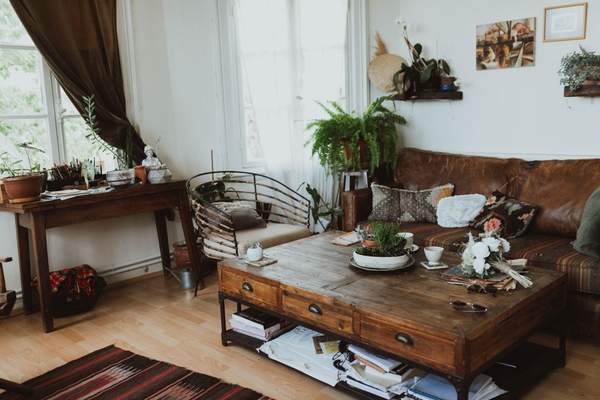
How do you choose boho rugs for living room spaces?
Choose boho rugs for living room spaces by matching the rug to your seating footprint first, then picking one dominant pattern and a manageable texture. An 8 x 10 ft rug often suits a 12 x 15 ft room with a standard sofa. Keep front furniture legs on the rug, and test colors in your actual daylight.
A boho rug should feel collected, not crowded. Measure your furniture, then choose a rug that connects the seating without obstructing the paths you actually use.
What makes a rug look boho in a living room?
A boho rug typically has visible texture, an informal pattern, or a slightly irregular, handwoven appearance. It does not require tassels, a busy print, and several layers at once; one strong detail is enough.
Think of the rug as the room’s largest textile. Low-pile weaving lets detailed furniture remain prominent, while uneven tufting makes a simple arrangement feel more relaxed. A boho living room rug should be readable from the doorway, not merely appealing in a close-up photograph.
Inspect the edge finish and pile before purchasing. Fringe can catch beneath a chair, and long fibers can trap crumbs. The broader living room rug guide helps settle the footprint before you become attached to a particular design.
Which boho rug patterns work with simple furniture?
Faded medallions, open diamonds, broken stripes, and small repeated motifs work with furniture that has uncomplicated outlines. A large-scale motif brings personality to a plain sofa, while a fine repeat behaves more like texture.
Seven boho rug looks by pattern and texture
- Faded medallion: Best with a plain sofa; its center anchors the conversation area. Make sure the coffee table does not conceal the entire motif.
- Broken kilim stripe: Useful in a narrow room because an irregular stripe adds direction without a rigid grid. Align it with the longest sofa.
- Open diamond flatweave: A strong fit with low-profile furniture. Spaces between motifs prevent the floor from appearing packed with detail.
- Small repeated motif: Ideal beside a statement chair. Viewed from across the room, the fine design reads as texture rather than competition.
- High-low tufted geometry: Adds movement below simple seating. Check whether a vacuum can reach the grooves between raised areas.
- Handwoven jute foundation: Adds a coarse surface under a smaller decorative rug. Choose it only if the natural fibers suit your household.
- Asymmetrical abstract weave: Mixes comfortably with modern frames and vintage pieces. Broad shapes are easier to coordinate than scattered miniature motifs.
Use the pattern comparison below when shopping. It exposes practical trade-offs that product photographs often hide.
| Rug pattern | Furniture it suits | Likely drawback |
|---|---|---|
| Faded medallion | Solid sofa and simple chairs | Center disappears under a large table |
| Broken stripe | Long sofa and narrow layout | Direction emphasizes room length |
| Open diamond | Low-profile sofa | Large motifs compete with printed upholstery |
| Small repeated motif | Patterned accent chair | Detail is hard to see from afar |
| High-low geometry | Minimal seating | Raised pile is slower to clean |
A flatweave may look soft on screen yet feel stiff beneath bare feet, and fine motifs may disappear under normal room lighting. Request a sample.
How do you choose colors for a boho living room rug?
Build around one backdrop, one dominant textile color, and one restrained accent. Allocate approximately 60 percent of the visible room to the backdrop, 30 percent to rug and upholstery, and 10 percent to accents; assess the scheme in your daylight.
Use Benjamin Moore Pale Oak, approximated here as #D8CFC4, on the largest surrounding surfaces. It provides a reference for about 60 percent of the room without requiring identical colors in rug and wall finishes.
#D8CFC4 · Benjamin Moore Pale Oak
South-facing sunlight makes it appear warmer; north-facing light pulls it grayer. Use it across roughly 60 percent of the visible scheme.
Match the major rug motif or substantial upholstery to Sherwin-Williams Cavern Clay, #AC6B53, for approximately 30 percent of the visual area. Bring a rug sample alongside an actual paint chip before deciding.
#AC6B53 · Sherwin-Williams Cavern Clay
South-facing light intensifies its orange warmth, while north-facing light makes it look more brown. Target about 30 percent across the dominant textile and upholstery.
Use Sherwin-Williams Naval, #2F3D4C, for the remaining 10 percent in smaller rug details and removable accessories. Keeping this shade limited gives the pattern definition without making the seating area feel dark.
#2F3D4C · Sherwin-Williams Naval
North-facing light makes this accent read deeper and cooler; south-facing light brings out more blue. Keep it to roughly 10 percent of the visible room.
These proportions describe visible surfaces, not the amount of paint to buy. Stand the sample beside the sofa in the morning and afternoon, then inspect it under evening lamps. Dyed fibers and painted walls will not necessarily reproduce identical digital colors.
Can you layer a boho rug over jute?
Yes, a patterned rug can sit over a larger jute base if both lie flat and resist sliding. Leave enough of the lower rug visible that the layering looks deliberate rather than like two mismatched sizes.
For jute rugs for living room spaces, select a base that reaches beneath the seating group. Center the top piece with an 8 to 12 in border where possible, and choose a pad or grip system approved for both materials and your floor finish.
A chair leg balanced on the upper rug’s edge will wobble, so reposition the top piece away from frequently moved seating. For more examples, see layered rugs living room and outline both rugs with removable tape before ordering.
Jute sheds, can feel rough to bare feet, and is difficult to clean after spills. A thick upper layer creates a trip edge. A pretty arrangement beneath an unused accent chair may be irritating on a daily walkway, so prioritize flat edges over a dramatic photograph.
What size boho rug works under a sofa and chairs?
Choose a rug that takes the front legs of the sofa and principal chairs, not one floating between them. For a 12 x 15 ft room, an 8 x 10 ft rug is a useful starting outline, although the seating footprint decides the fit.
Measure the outside edges of the furniture, then tape out the rug on the floor. Leave space for chair movement and a clear walk into the seating area; a rug whose corner catches your normal route is awkwardly positioned.
- Example rug for a 12 x 15 ft room 8 x 10 ft
- Sofa front legs on rug 8 to 12 in
- Rug beyond sofa ends 6 to 12 in
- Sofa to coffee table 16 to 18 in
- Main walkway clearance 30 in minimum
- Top rug inset from jute base 8 to 12 in
For a sectional or spread-out conversation arrangement, explore 9 x 12 rugs for living room. If seating is tight, use the living room rug layout guide to check whether repositioning furniture would help more than buying a smaller rug. Open the doors and move the chairs inside your taped outline before committing.
When is a boho rug the wrong choice for a living room?
A thick, shaggy rug is a poor fit if you use a rolling office chair in the living room, rely on a robot vacuum that catches fringe, or regularly clean up food dropped by young children. Deep pile hides debris, tassels snag, and an unsecured edge becomes a daily nuisance. Some styled photographs show a tiny rug floating in front of a sofa without any furniture resting on it. That can look appealing from one camera angle, but it disconnects a real seating group.
Layering has limits. Two rugs create a ridge exactly where people walk, particularly in small apartments. A jute base may be abrasive for children playing on the floor and unforgiving when pets have accidents. Costly hand-knotted pieces are not automatically the best choice if frequent washing matters. On a tight budget, spend on an adequate footprint and the right pad instead of decorative fringe.
North-facing rooms can flatten subtle motifs in low daylight. Bring a sample home first and reject a rug whose care instructions do not match your household, however attractive its listing looks.
Frequently asked questions
Do boho rugs need to be vintage?
No. New flatweaves, distressed-look pieces, and hand-tufted designs can look collected without being antiques. Evaluate construction and care instructions rather than a retailer’s style label.
Are washable boho rugs useful in busy homes?
They can help with spills, provided the rug fits your washer and the manufacturer permits machine cleaning. Use its specified pad and follow drying directions so the edges remain flat.
Should the rug match the curtains?
An exact print match is unnecessary. Repeat one identifiable shade or pattern scale instead of using the same motif on every textile.
Is fringe practical beside a doorway?
Not usually on a heavily traveled path. Choose a bound edge, or position the fringe beyond the door swing where it will not catch.
How can I check the rug color before ordering?
Request a sample and lay it next to the largest upholstered piece. Check it in the room’s daylight and again under the lamps you use at night.
Start with size, then choose one pattern and a texture your household can maintain. A restrained color plan will give the room more character than extra fringes or unnecessary layers.