
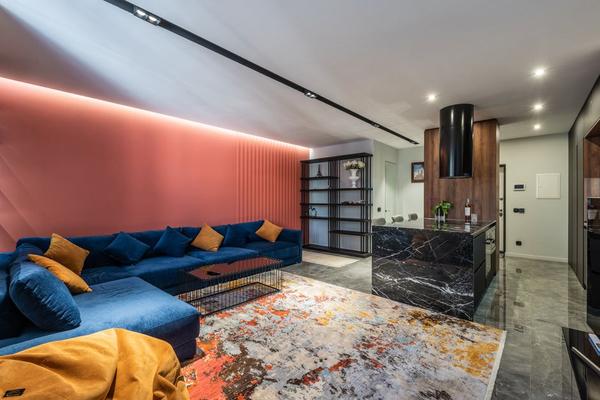
How do you choose abstract living room rugs that suit your furniture?
Choose abstract living room rugs with a pattern scale that suits the sofa, then size the rug so the main seating pieces have at least their front legs on it. Keep the busiest marks away from crowded furniture legs, repeat one rug color elsewhere in the room, and check a sample in daylight.
An abstract rug can connect furniture that otherwise feels unrelated, but the part visible around the furniture matters most. Start with the seating footprint, not an empty-room product photograph.
What abstract rug patterns work in a living room?
Broad curves, offset blocks, irregular lines, and controlled color fields all work when their key marks remain visible. Pick a design whose scale makes sense beside the sofa and coffee table, rather than one that looks exciting only when spread across an empty floor.
Six patterns that can balance a seating arrangement
- Overlapping curves: A strong choice beside a straight-armed sofa and rectangular table. Look for a curve broad enough to remain recognizable around the table. Verdict: a useful counterweight to angular furniture without adding another hard edge.
- Offset geometric blocks: Useful for visually connecting a sofa and two separate chairs. Avoid a composition where every major block disappears beneath furniture. Verdict: disciplined movement that suits contemporary living room rugs without looking mechanically repetitive.
- Fine irregular lines: An option for compact groups where large shapes would be mostly hidden. View the sample from 6 ft away; a dense design that seems to shimmer will feel distracting. Verdict: subtle structure beneath substantial seating.
- Asymmetric brushstrokes: Helpful when furniture placement is very symmetrical. Position the largest stroke toward exposed floor, not directly under the coffee table. Verdict: expressive, provided the signature stroke can actually be seen.
- Soft-edged tonal fields: A quiet way to add movement beneath a large sectional. Choose areas with clearly defined transitions; a blurred pattern without structure can resemble a stain. Verdict: visible texture without a central image demanding attention.
- Scattered pebble shapes: Effective beneath a round or oval table when the motifs are substantially larger than small tabletop objects. Verdict: playful, but keep surrounding accessories restrained so the room does not become visually crowded.
For abstract rugs for living room searches, favor product photographs with realistic furniture. An 84 in sofa and a 48 in coffee table cover much more pattern than an empty catalog shot suggests. First decide which living room rug footprint keeps the visible design coherent.
How large should an abstract living room rug be?
Size the rug for the entire conversation area, not only the gap between the sofa and television. An 8 x 10 ft rug can work with closely grouped seating, while a 9 x 12 ft rug often gives spread-out chairs more room; measure the actual leg positions before buying.
- Rug beneath sofa front legs 8 to 12 in
- Sofa to coffee table 16 to 18 in
- Walking route beside seating 30 in minimum
- Typical three-seat sofa width 84 in
- Useful rug in a 12 x 15 ft room 8 x 10 ft
Mark the rug’s border on the floor with removable painter’s tape. Check that all intended front feet are supported, doors still open, and no rug edge interrupts a main walking route. A dramatic motif near the border needs uncovered perimeter to be appreciated.
| Furniture arrangement | 8 x 10 ft rug | 9 x 12 ft rug |
|---|---|---|
| 84 in sofa with compact chairs | Often fits closely grouped front legs | Supports a wider chair spread |
| Large sectional with return | May miss one front leg | More likely to connect both sections |
| 12 x 15 ft room | Usually leaves an exposed perimeter | Requires careful doorway clearance |
| Pattern concentrated at rug edge | Less artwork remains visible | More border may show around seating |
Neither size is automatically correct. Use living room rug layout for furniture positioning and living room rug measurements when checking a particular room before ordering.
How do you coordinate an abstract rug with sofa colors?
Repeat a color already represented in the rug instead of inventing a separate scheme for the sofa. A workable visual balance is about 60 percent walls and ceiling, 25 percent upholstery, 10 percent visible rug, and 5 percent accessories; these percentages describe visual presence, not measured surface area.
For the largest surfaces, use Benjamin Moore Pale Oak as a paint-match reference, approximately #D8CFC4. Apply it to roughly 60 percent of the visible room through walls and ceiling, and inspect a real sample before buying paint.
#D8CFC4 · Benjamin Moore Pale Oak
Appears warmer and slightly pink in south-facing sunlight; north-facing light pulls it grayer. Allocate roughly 60 percent of the visible room to this reference.
For the sofa, consider Benjamin Moore Hale Navy, approximately #434B56, as a color-match reference when selecting upholstery. Aim for about 25 percent of the visible scheme, then repeat a small amount of that reference in the rug design.
#434B56 · Benjamin Moore Hale Navy
Reads deeper and cooler in north-facing rooms and clearer in strong south-facing light. Reserve about 25 percent of the visible palette for matching upholstery.
Let the rug occupy the 10 percent pattern share and accessories the final 5 percent, reusing those references rather than adding competing colors. Paint chips are guides, not promises that textile dyes will match; lay actual samples side by side near the window. Check both cloudy and bright conditions.
Can an abstract rug work with patterned curtains or pillows?
Yes, when the rug carries the largest marks and the other textiles use a visibly smaller scale. Repeat an existing color reference and keep the window treatment or pillows from competing with the rug for attention.
Stand at the doorway and photograph the room with the curtains open and closed. If both the curtain print and rug immediately demand attention, remove one competing pattern. An 18 in printed pillow is a smaller visual commitment than a full-height curtain panel, so try that first. When buying accent rugs for living room arrangements, use pattern to guide the eye rather than fill every empty surface.
Where should the strongest part of an abstract pattern sit?
Place the dominant mark in clear floor space just beyond or beside the coffee table, where it remains legible from the room entrance. It should visually connect the seating group without making the sofa or chairs appear crooked.
Draw the sofa, chairs, and table to scale on paper; then trace where the rug’s biggest marks will fall using the overhead product image. Try rotating the rug 180 degrees if the layout seems unbalanced. A central burst hidden under a solid 48 x 24 in table contributes almost nothing, while a visible sweep at the edge can give the whole group direction. Keep the most striking section away from a crowded cluster of chair legs.
When will an abstract rug make a living room look worse?
It can fail badly in a narrow room. A sweeping design that looks impressive in a showroom photograph may turn into unrelated fragments beneath a sofa, storage cabinet, and coffee table. Photographs with huge exposed rug borders and hardly any furniture do not represent how most families use a living room. Do not buy a rug on the assumption that your room will somehow resemble that staged image.
Fine, low-contrast prints can disappear in north-facing light when upholstery covers the strongest marks. Extremely busy prints can become tiring beside toys, books, cables, and patterned curtains. Homes with pets or young children need more than a pretty listing image: check cleaning instructions, pile construction, backing, and returns. An intricate design will not make an unsuitable fabric easier to maintain.
Finally, do not sacrifice the 30 in walking route or force a rug too close to a door simply to make the furniture look centered. If your budget only covers a small statement rug that misses most seating legs, choose a simpler correctly sized piece instead. Proportion matters more than spectacle.
Frequently asked questions
Should the coffee table be centered on the rug?
Center the table on the seating group first. A slight offset on the pattern is fine if the main design remains visible and the table stays 16 to 18 in from the sofa.
Do I need a pad beneath an abstract rug?
A suitable rug pad can reduce movement and add comfort. Choose a pad approved for your flooring and rug backing, and check the added thickness beneath swinging doors.
Is a low-pile abstract rug suitable for a sectional?
Yes, particularly where furniture is heavy and regular cleaning matters. Confirm the front legs fit and the pattern remains visible around the sectional’s return.
Must the rug extend equally beyond both sofa arms?
No, perfect symmetry is not essential. Position it to support the seating legs and keep the most recognizable pattern visible from the main entrance.
What should I inspect before ordering a rug online?
Find the full overhead image, exact size, close-up texture photographs, and return terms. Compare the design with a measured furniture sketch, and order a sample if available.
Choose the rug whose pattern still makes sense once the furniture covers its middle. A measured footprint, an exposed focal mark, and color samples viewed in your actual daylight are more useful than a perfectly styled catalog photograph.