
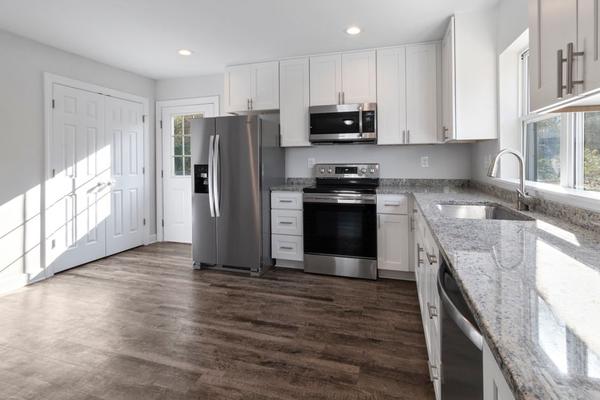
How should you plan luxury home renovations watertown ma?
Plan luxury home renovations watertown ma from the house outward: correct structural, moisture, electrical, plumbing and layout problems before buying visible finishes. Lock cabinet and circulation dimensions early, retain sound older-house materials where practical, test one exact paint color in both orientations, and keep a short finish schedule so every room relates to the next.
For luxury home renovations watertown ma, the expensive-looking part should come last, not first. In an older house, a disciplined sequence protects the budget and gives the final rooms the calm, fitted result people expect from a luxury home renovation.
A watertown home luxury renovation should start with what cannot easily be changed later: structure, services, floor levels, openings and fixed cabinetry. A watertown whole home luxury renovation also needs one set of dimensions and finish decisions carried through the entire house rather than a collection of unrelated room makeovers.
What should Watertown MA homeowners renovate first?
Start with conditions that can damage or constrain everything installed after them, then move toward fixed layout and visible finishes. For luxury home renovations watertown ma, that means making the house sound and workable before spending heavily on cabinetry, stone, lighting or furniture.
- Resolve structure and water first: Have qualified professionals investigate movement, framing concerns, leaks and recurring dampness before decorative demolition or finish orders begin.
- Plan electrical, plumbing and heating routes: Decide where major fixtures, appliances, lighting and controls belong while walls and floors are still accessible, and use licensed trades for work that requires them.
- Correct the room geometry: Address noticeably uneven floors, damaged plaster, out-of-square openings and trim conditions before accurate cabinetry or built-ins are measured.
- Freeze the kitchen and bath layouts: Confirm appliance, sink, vanity, shower and storage locations before cabinet drawings become orders.
- Set the finish sequence: Schedule flooring, millwork, cabinetry, counters, tile and paint so completed surfaces are not repeatedly cut, patched or protected from later heavy work.
- Bring in furniture last: Buy the pieces that depend on final clearances only after the fixed dimensions are confirmed on site.
This order also makes scope decisions easier. If you are comparing nearby Massachusetts whole-home planning approaches, belmont whole home luxury renovation and brookline whole home luxury renovation are the most relevant related pages in this pillar.
Which materials suit older-home constraints and four seasons?
Choose materials that can be installed accurately over an older building without pretending every surface is perfectly flat, square or motionless. Give priority to repairability, stable substrates and transitions that can accommodate small irregularities without making the work look careless.
| Older-home application | More forgiving choice | Higher-control choice |
|---|---|---|
| Main living-area flooring | Existing sound wood repaired and refinished, preserving the established floor height | New wide solid-wood boards, which need careful moisture and substrate control before installation |
| Bathroom floor | Smaller porcelain tile on a properly prepared, stiff substrate, allowing cleaner adjustment at edges | Very large tile, which exposes unevenness quickly and demands a flatter prepared surface |
| Kitchen work surface | Engineered quartz fabricated after final cabinet installation and field measurement | Large natural-stone slabs, which require careful templating, seam planning and support |
| Wall finish | Sound original plaster repaired locally before paint, keeping the older wall character | Full new board finish, which creates a straighter plane but can expand the demolition scope |
| Interior millwork | Custom-fitted wood trim scribed to existing walls and openings | Pre-sized trim packages, which leave less room to absorb irregular corners and reveals |
Luxury in an older home comes from fit, alignment and choosing materials whose installation requirements can actually be met.
What dimensions should be fixed before cabinetry and furniture are ordered?
Fix the dimensions that control circulation, cabinet depth, appliance fit and furniture relationships before deposits are placed. A half-inch change at one wall can affect fillers, door swings, counter overhangs and the amount of walking space left after installation.
- Base cabinet depth 24 in
- Upper cabinet depth 12 in
- Kitchen work aisle 42 in minimum
- Main circulation path 36 in minimum
- Sofa to coffee table 16 to 18 in
- Dining chair pull-back zone 36 in from table edge
Measure finished surfaces, not framing assumptions. For custom cabinets, built-ins and stone, final field measurement should happen after the surfaces that control the fit are in position.
How should exact paint colors be tested in north- and south-facing rooms?
Test one exact candidate on large areas in both orientations and look at it in morning, midday and evening light before committing the whole house. Benjamin Moore Pale Oak at #D8CFC4 is a practical single-color starting point for painted walls and ceilings because you can judge the same formula against different daylight rather than comparing several unrelated colors at once.
#D8CFC4 · Benjamin Moore Pale Oak
Reads warmer and very slightly pink in south-facing light; in a north-facing room it drops noticeably grayer. Use it on walls and ceiling for roughly 60 percent of the visible room, with about 25 percent left to existing wood or stone surfaces and 15 percent to fixed furnishings and accents.
North-facing rooms pull a paint choice cooler and grayer, while south-facing rooms make the same paint read warmer. Check the sample beside the actual floor, millwork and countertop surfaces that will remain, because a paint decision made against an empty wall can shift once those large fixed materials return to the room.
For luxury home renovations watertown ma, keep the testing method consistent from room to room. Use the same sample size, view it against the final fixed materials, and record the chosen manufacturer, color name and code so touch-ups and later rooms do not depend on memory.
How do you keep finishes cohesive from one room to the next?
Use a short whole-house finish schedule and repeat decisions that are visible across doorways: flooring transitions, trim profile, cabinet construction language, hardware finish and the main paint specification. Cohesion comes from repetition and controlled changes, not from making every room identical.
Keep one dominant architectural language for the fixed elements, then let room function determine the smaller differences. If a kitchen needs more durable surfaces or a bath needs tile, the detailing should still line up with the rest of the house through consistent reveals, edge thicknesses, trim relationships and hardware families.
Before ordering, record each fixed finish by room, material, supplier, product name, size, surface and stopping point. That schedule reduces accidental substitutions when several trades are working at once.
When does a luxury renovation plan not work in an older home?
It does not work when the budget covers visible finishes but not the hidden conditions that make those finishes possible. Full-height stone walls, extra-wide floorboards, oversized islands and wall-to-wall custom cabinetry can look convincing in photographs, yet they become poor choices when an older room is narrow, the floor is uneven, the walls need substantial repair or the mechanical systems still need money. A small kitchen does not become more luxurious by forcing in an island that cuts the work aisle below a comfortable 42 in.
It also fails when every original surface is removed simply because a replacement is newer. Sound plaster, usable wood flooring or distinctive trim can be worth repairing if they fit the project, while indiscriminate demolition can consume money without improving daily use. On a tight budget, spend first on structure, water control, safe systems, accurate cabinetry fit and good lighting. Delay decorative upgrades that can be changed later. In low north-facing light, do not approve paint from a bright showroom chip; the room itself has to decide.
Frequently asked questions
Do I need a professional before changing walls in an older Watertown house?
Use a qualified architect, engineer or relevant trade when the work may affect structure, building systems or code-controlled construction. Do not treat an existing wall as non-structural based only on how thin it looks or where it sits in the room.
Can original plaster stay in a high-end renovation?
Yes, if it is sound enough to repair and supports the finish quality you want. Keeping good plaster can preserve the proportions of existing trim and openings, while damaged or unstable areas should be assessed before finish work proceeds.
When should custom cabinetry be ordered?
Order after the layout is frozen and the conditions that control fit are understood, then require final field verification before fabrication where the maker’s process allows it. Older rooms often contain small irregularities that a drawing based only on nominal dimensions can miss.
What makes luxury home renovations watertown ma feel cohesive rather than overdesigned?
Use fewer fixed finish families and repeat them deliberately across connected rooms. Precise alignment, consistent trim relationships, controlled transitions and well-planned clearances usually read more convincingly than adding a different statement material in every space.
Should furniture be bought before renovation work begins?
Choose key sizes early enough to protect the layout, but avoid final purchases that depend on finished clearances until those dimensions are confirmed. This is especially important for large sofas, dining tables and pieces that must pass through older doorways or stairs.
A successful older-home renovation is less about adding expensive surfaces and more about making the sequence, dimensions and finish decisions agree with the building you actually have. For luxury home renovations watertown ma, solve the hidden constraints first, document the fixed choices, and let the visible luxury come from accurate fit and restraint.