
What are the best gazebo lights ideas for everyday use?
The best gazebo lights ideas combine an overhead light for the table, low-level lighting around steps and paths, and softer perimeter light for relaxing. Keep dining light centered, place path lights where feet change level, use outdoor-rated fittings, and choose about 2700K to 3000K so faces and food look comfortable after dark.
Start with tasks, not with a box of string lights. Decide where people eat, walk, sit and enter, then light each zone without making the whole structure bright.
Use the broader light ideas guide to connect the gazebo with the yard. For an adjoining deck, ideas for decking lights can carry the same approach across stairs, rails and walking edges.
Where should lights be placed inside a gazebo?
Put the brightest fixture over the activity that needs the clearest view, usually the dining table, then add lower-output light at entrances, steps and seating edges. Keep perimeter lighting outside the main sightline so people can look across the gazebo without staring into exposed bulbs.
Organize gazebo lights ideas by zone. That keeps one central fixture from doing every job and lets you change the lighting when dinner shifts to conversation.
A practical zone-by-zone lighting list
- Center the dining light over the table: Align a pendant or compact chandelier with the table center so plates and faces receive useful light without bright perimeter spill.
- Trace the main walking route: Put shielded path or step lights at level changes, corners and the approach so the route stays visible without eye-level glare.
- Light the seating perimeter indirectly: Use downward wall lights or concealed low-output strips near posts and rails so seating edges remain visible without task-level brightness.
- Keep entry points obvious: Give each commonly used entrance its own light source so the threshold is easy to read from both inside and outside the gazebo.
- Control decorative light separately: Small string lights can support decoration with lights ideas, but use them as atmosphere rather than the only source for dining or safe movement.
- Use twinkle lights sparingly: Borrow from indoor twinkle lights ideas under a covered roof, but keep the pattern simple so the roof does not look busy.
How high should string or pendant lights hang over a gazebo table?
For a pendant over a dining table, aim for the bottom of the fixture to sit about 30 to 36 inches above the tabletop, provided the fixture remains clear of standing head height around the table. For string lights, keep the lowest sag high enough that a standing adult can move beneath the open areas without brushing the cable or bulbs.
Gazebo ceilings can be low. A long pendant may look proportionate in a product photo yet sit too low once a 30-inch table and seated sightlines are considered.
- Pendant bottom above dining table 30 to 36 in
- Typical dining table height 30 in
- Clear headroom in open walking areas 7 ft minimum
- String-light attachment spacing 6 to 10 ft between secure support points
- Path light setback from walkway edge 6 to 12 in
Do not hang electrical fittings from decorative trim, lightweight lattice or a roof member that has not been confirmed as suitable for the load. Any new permanent wiring, junction box, circuit or hardwired fixture should be installed or verified by a qualified electrician for outdoor use.
Which outdoor-rated fixtures work best around gazebo edges?
Use fixtures specifically listed for the exposure they will receive, not indoor products that happen to fit under a roof. Covered perimeter locations still face humidity, wind-driven rain and condensation, while fixtures near open edges may need a higher level of weather protection.
Choose the installation type in the table below based on existing power, how permanent the gazebo is and whether the property owner allows alterations.
| Gazebo use or location | Hardwired outdoor fixture | Plug-in or low-voltage fixture |
|---|---|---|
| Dining table under a permanent roof | Strong fit for a centered pendant or ceiling fixture on a dedicated wall control | Useful when a listed hanging light can be connected without creating a cord route through walking space |
| Posts and perimeter rails | Clean installation for shielded sconces where wiring can be concealed safely | Good for removable accent lights where permanent alterations are not allowed |
| Steps and path edges | Suitable for integrated step lights when the structure is being built or renovated | Practical for low-voltage path lights that can be repositioned as planting or furniture changes |
| Rental or temporary gazebo | Usually inappropriate unless the owner has approved the work and a qualified electrician completes it | Better suited to reversible lighting that uses existing approved power points and removable supports |
| Year-round entertaining | Best suited to frequent use where fixed controls and concealed wiring matter | Useful as an added decorative layer that can be removed for storms, maintenance or seasonal storage |
Check the fixture and instructions for a recognized listing mark and stated location rating. Outdoor styling alone does not prove damp- or wet-location approval, and extension cords are not permanent wiring.
What color temperature makes a gazebo feel comfortable at night?
For dining and relaxing, use 2700K as the default because it keeps the light gentle on faces and wood surfaces. If a separate food-prep spot needs clearer task light, keep that source at no more than 3000K and keep the main seating area consistent.
Brightness and shielding matter too. Aim light onto the table or walking surface and keep bare high-output bulbs out of seated sightlines.
If the ceiling or upper trim needs a light-reflective paint, Benjamin Moore Chantilly Lace (#F5F4EF) is a specific reference. Use it where you want the structure to return some 2700K lamp light without making the ceiling visually heavy.
#F5F4EF · Benjamin Moore Chantilly Lace
In south-facing daylight it reads slightly warmer and brighter; in north-facing light it can look cooler and more restrained. Use it on the ceiling and upper trim, roughly 25 percent of the gazebo’s visible painted surfaces.
After sunset, judge the result from the seats you use. If bare filaments or LEDs are visible from dining chairs, add shielding, lower output or reposition the fixture.
When do gazebo lighting ideas not work well on a tight budget or in a rental?
A layered scheme can become poor value fast if the gazebo has no safe power source, the roof cannot support a hanging fitting, or the landlord will not approve permanent wiring. In those cases, the sensible plan is to light the path and table with reversible outdoor-rated products rather than imitate a fully wired installation.
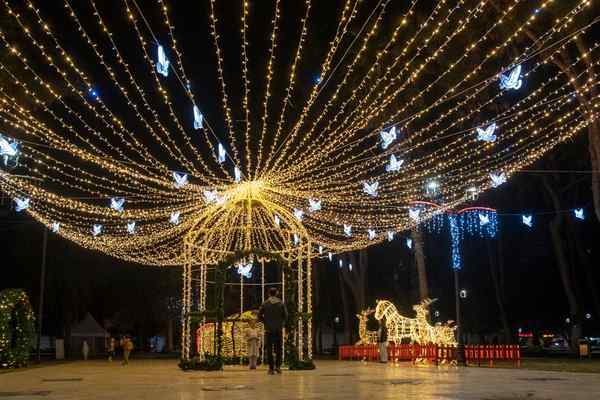
The dense ceiling of string lights seen in styled photographs is one idea that often works better in a picture than in daily use. With strands crossing every foot or so, there are more attachment points, more visual clutter, more hardware to inspect and more glare if clear bulbs sit in direct sightlines. Oversized chandeliers have the same problem in a compact gazebo: they can dominate the roof area and reduce comfortable headroom even when the scale looks dramatic online.
Do not staple cables to a rental structure, drill posts without permission or treat an indoor extension cord as a permanent outdoor feed. If the only available outlet creates a cord across a walkway, change the lighting plan instead of accepting a trip and weather risk.
Frequently asked questions
Can solar lights provide enough light for a gazebo dinner?
Solar lights can support path marking and gentle accent light, but output depends on the panel, battery and daily sun exposure. For a table where people need to see food clearly, use a product whose real light output and runtime are suitable for the evening rather than relying on decorative solar stakes alone.
Can I use indoor string lights in a covered gazebo?
Use only string lights whose manufacturer identifies them for the outdoor location you have. A roof does not eliminate humidity, condensation or wind-driven rain, so an indoor-only set is not made for the exposure.
Should gazebo lights be dimmable?
Dimming is useful when the same gazebo shifts from dining to quiet conversation because it lets one fixture serve more than one mood. Use compatible lamps, controls and outdoor-rated equipment, and have permanent electrical changes handled by a qualified electrician.
How many lighting layers does a gazebo need?
Most gazebos benefit from three functional layers: table or task light, safe route lighting, and a softer perimeter or decorative layer. A very small structure may use fewer physical fixtures if one shielded fitting can cover more than one function without glare.
The most useful gazebo lights ideas are the ones that make eating, walking and relaxing easier without filling every roof line with bulbs. Start with the table and path, add perimeter light only where it solves a real need, then check the result from seated eye level after dark before adding anything else.
1 thought on “Gazebo Lights Ideas for Dining, Paths and Relaxing”