
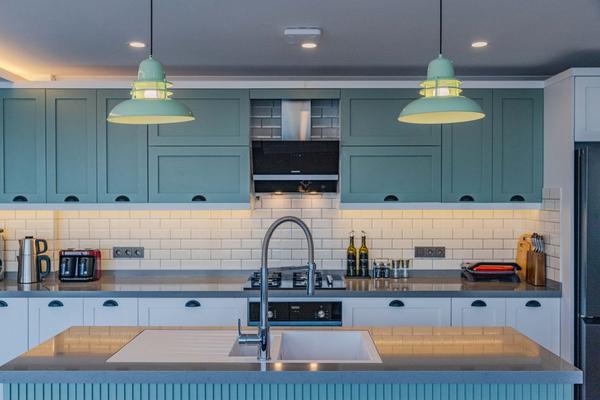
Can paint colour olive green work on walls, cabinets, and trim?
Yes. Paint colour olive green works when its yellow-gray undertones complement existing wood and stone. Use a medium olive on bright walls or cabinets, and reserve deeper versions for smaller accents. Pair it with a light named paint, choose realistic room proportions, and test samples in morning and evening light before buying gallons.
Olive is not one identical shade on every surface. The same chip can look golden next to flooring, gray in a shaded corner, or almost black on cabinetry.
Definition: Olive green is a green visually softened with yellow, gray, or brown. It differs from vivid green because its lower saturation makes existing materials, and the direction of daylight, more noticeable.
What undertones define an olive green paint?
Olive generally starts with yellow-green and is restrained by gray or brown. The yellow makes it warmer, while darker versions can look nearly charcoal in weak light.
Compare a painted sample beside the real counter, flooring, and trim, not against a color chart alone. A shade that looks green next to white paper can appear brown next to oak or yellow beside blue-gray stone.
Sherwin-Williams Olive Grove SW 7734, approximately #857C5D in digital color, is a practical medium-depth olive with noticeable yellow-brown influence. It provides a useful reference before you consider darker cabinetry.
#857C5D · Sherwin-Williams Olive Grove SW 7734
North-facing light makes it grayer; south-facing sun emphasizes its yellow-brown side. In a bright room, it can cover roughly 60 percent of visible color on walls.
A hex value helps organize samples but cannot reproduce actual paint on every screen. Select a physical manufacturer sample and the intended sheen. Among earthy green paint colours, this undertone check is more useful than a label on the can.
Which surfaces suit olive green best?
Medium olive works on well-lit walls and lower cabinetry, while deep olive is safer as an accent. Trim is possible, but painting narrow edges dark changes how doors and windows are outlined.
For walls, sample a broad uninterrupted section. A 12 x 15 ft room with an 8 ft ceiling has approximately 432 square feet of gross wall surface before subtracting openings; a postcard-sized chip cannot predict that visual coverage.
Kitchen cabinets receive grease, frequent wiping, and contact around handles. Choose a coating specifically rated for cabinets, and follow its preparation, priming, and curing instructions rather than applying ordinary wall paint to doors.
| Painted surface | Practical use for olive | Check before committing |
|---|---|---|
| Living-room walls | Continuous color in substantial daylight | Darkest corner and opposite window wall |
| Lower cabinets | Defined color beneath lighter walls | Counter undertone and wipeable finish |
| Door and baseboard trim | Dark outline around lighter walls | Full-length profile against flooring |
| Kitchen island | Contained accent without painting every cabinet | Views from connected rooms |
For a rental, display samples on removable boards and obtain written permission before repainting. Do not assume cabinet or trim paint can be reversed without cost.
- Wall sample patch 24 x 24 in
- Cabinet sample panel 12 x 18 in
- Trim test length 24 in
- Counter-to-upper-cabinet gap to inspect 18 in
What colors pair well with olive green walls or cabinets?
A light paint and visible natural materials keep olive from overwhelming the room. Choose exact samples and decide what percentage each painted surface will occupy before shopping.
Benjamin Moore Pale Oak OC-20, approximately #DDD9CE, is a useful light wall or ceiling partner for olive cabinetry. Compare it directly against fixed stone before assuming the pairing is balanced.
#DDD9CE · Benjamin Moore Pale Oak OC-20
It appears grayer in north-facing daylight and warmer beige in southern sun. Use it on roughly 60 percent of the visible room when olive covers about 30 percent.
Sherwin-Williams Ripe Olive SW 6209, approximately #44483D, offers a much deeper accent on an island or single door. Its low reflectance makes an entire dim kitchen of this color difficult to live with.
#44483D · Sherwin-Williams Ripe Olive SW 6209
It looks almost charcoal in northern shade and more visibly green in southern sunlight. Restrict it to around 10 percent of visible room color as an accent.
For bright wall-led rooms, plan about 60 percent Olive Grove, 30 percent Pale Oak on ceiling and trim, and 10 percent existing wood, stone, and hardware. For cabinet-led rooms, start with 60 percent Pale Oak, 30 percent Olive Grove, and 10 percent other visible finishes. Those ratios describe what you see, not paint quantities.
If your sample resembles moss green paint colour more than olive, compare it against sage green paint colours. The wider green paint colours guide offers other green families before you commit.
How does olive green change in north-facing light?
North-facing daylight usually makes olive look cooler, grayer, and heavier. South-facing light reveals more yellow or brown, although exterior shade and window size can change the result.
Look at samples opposite the window and beside the floor. Check the paint again after sunset under the bulbs normally used in the room, not just at midday.
| Paint or planning choice | North-facing daylight | South-facing daylight |
|---|---|---|
| Olive Grove SW 7734 | Grayer; may weigh down broad walls | Yellower; test beside flooring |
| Pale Oak OC-20 | Cooler and relatively light | Beiger; can heighten olive’s yellow notes |
| Ripe Olive SW 6209 | Nearly black away from windows | More visibly green in direct light |
| Olive coverage | Try about 30 percent on cabinets | Evaluate up to 60 percent on walls |
A north-facing kitchen may need the light paint across its larger surfaces and olive only below the counter. In a sunnier room, that allocation can be reversed, provided the olive still looks right beside the permanent finishes.
The same scheme also changes with viewing direction. Stand at the doorway looking toward the window, then face back into the room; reflected light can make the olive seem like a different paint.
How can you test the color before buying full cans?
Use real painted boards or manufacturer-approved samples for every candidate. Hold them vertically beside the finishes that will remain, and assess them at different times of day.
- Morning: Check the sample near the window and in its darkest corner.
- Midday: Look for yellow appearing beside counters or flooring.
- Evening: Switch on your normal lamps and look for a charcoal effect.
- Finish: Test the actual wall or cabinet coating, not just a flat chip.
A small set of samples is cheaper than repainting. Compare other interior paint green colours only after identifying the undertone you need.
When does olive green fail in a real room?
Dark olive on every wall and cabinet can be a bad choice in a narrow, north-facing kitchen with one small window. The room may lose contrast between counters, doors, and walls. Those dramatic all-green kitchens that look convincing in photographs often depend on exceptional daylight, professional lighting, and uncluttered surfaces. A dim working kitchen will not behave the same way.
Olive can also look unpleasant beside fixed flooring or countertops with strong pink, blue, or orange casts. If a large sample makes those materials look dirty, a glossier sheen will not fix the undertone conflict. Choose another green family or paint less area.
Dark cabinet doors expose dust, fingerprints, and rubbed edges, especially in homes with young children or pets. Proper cabinet preparation and curing can leave a kitchen disrupted for longer than expected. That makes an inexpensive-looking DIY makeover more costly than the photograph suggests.
If you rent and do not have written approval, do not paint doors or cabinets. Removable sample boards give you information without putting your security deposit at risk.
Frequently asked questions
Is olive green too dark for a small living room?
Not always; daylight matters more than square footage alone. Try a 24 x 24 in sample and limit olive to one wall if the room has only a shaded window.
Should olive kitchen cabinets be satin or semi-gloss?
Choose a manufacturer-approved cabinet product and test the finish it offers. Higher sheen highlights preparation flaws, while lower sheen can show rubbing and marks differently.
Can olive paint make old trim look modern?
It can make simple doors and moldings feel intentional, but dark outlines emphasize uneven edges. Test a 24 in length beside the actual flooring before painting every casing.
Can I order paint using a hex code alone?
No; use hex values to plan a palette, not as a guaranteed wall-paint formula. Buy a chip or sample of the named manufacturer color and approve it under your own lighting.
Olive works when the undertone fits what is already in the room and the painted area is measured visually, not guessed. Start with a generous sample, check the worst lighting, and then decide whether walls, cabinetry, or a smaller accent deserves the color.