
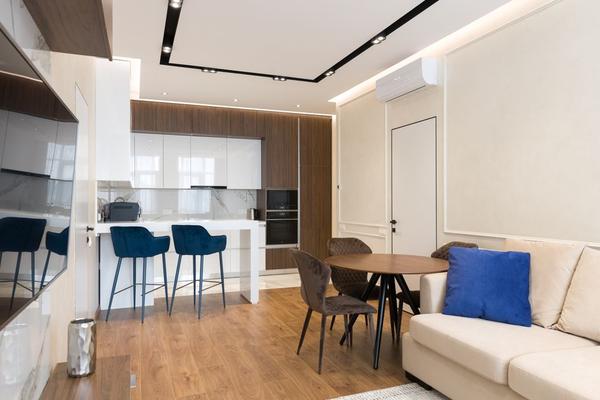
How do you choose modular furniture for small spaces?
Choose modular furniture for small spaces by measuring your doorways, walking paths, and the individual pieces—not just the assembled arrangement. Start with units that work independently, use repeatable connectors, and offer replacement parts. A sofa you can split, shelves you can reposition, and storage that stacks safely can adapt to another room or move.
A tiny apartment does not need furniture that performs a magic trick. It needs pieces you can carry through a doorway, rearrange without buying a new set, and use when your next floor plan looks nothing like this one.
What makes modular furniture useful in a small space?
Modular furniture consists of separate units designed to work together in different configurations. That flexibility matters when one room must serve as a living area, work zone, and guest space, or when a move changes the available wall length.
Start with the smallest useful version of a system. A pair of sofa seats, one movable ottoman, and a low storage unit may cover today’s needs without filling every corner. Later, an additional matching seat can extend the arrangement if the manufacturer still sells compatible components. Check that claim before buying: similarly named collections can change connector positions or dimensions between versions.
Think in usable modules, not showroom sets
For broader planning ideas, the small spaces furniture guide is a useful starting point; this checklist focuses on items that can survive a changed floor plan. If your rooms are visually busy, a consistent painted backdrop such as Benjamin Moore Pale Oak, represented here by #D8CFC4, can help separate the furniture layout from the wall surfaces.
#D8CFC4 · Benjamin Moore Pale Oak
Reads warm and very slightly pink in south-facing light. In a north-facing room it drops noticeably grayer. Use it on walls and ceiling, roughly 60 percent of the room.
Which modular pieces are easiest to reconfigure?
The best candidates have finished edges, manageable weight, and simple connections that do not require permanent installation. Choose pieces that still function if you own fewer modules later.
- Separate sofa seats: Choose individual seats around 28 to 34 inches wide with backs and connectors; the verdict is excellent flexibility if each section stands securely alone.
- Movable upholstered ottoman: Pick a roughly 24-by-24-inch unit that can join a sofa or serve as a footrest; the verdict is high utility without committing floor space to a chaise.
- Freestanding cube storage: A unit around 24 inches wide is easy to place under a window or beside a desk; the verdict is versatile, provided stacking follows the maker’s safety instructions.
- Modular desk sections: A separate work surface and rolling file cabinet can move to another wall; the verdict is strong for modular office furniture for small spaces when cables remain accessible.
- Nesting side tables: Tables around 16 and 20 inches tall tuck together between uses; the verdict is convenient, although they do not replace proper storage.
- Reversible shelving: Identical freestanding bays can form one run or two smaller units; the verdict is useful only when every configuration remains stable and appropriately anchored where required.
For rooms that change purpose daily, multifunctional furniture for small spaces can be useful, but check that folding mechanisms are practical to operate.
How do you measure modules so they fit more than one layout?
Measure every module in its assembled and disassembled states, then draw at least two possible arrangements to scale. A piece that fits the room’s wall may still fail at the doorway, stair turn, elevator, or walking route.
Measure wall lengths, door openings, baseboard projections, radiators, outlets, window swings, and the space needed to pull chairs out. For a 10-by-12-foot room, draw the boundary on graph paper at 1 square per 6 inches. Then cut paper rectangles to represent each section, not the full sofa; you will see whether a 32-inch seat can turn a corner or whether the ottoman blocks circulation.
- Individual seat width 30 to 34 in
- Small ottoman footprint 24 x 24 in
- Sofa to coffee table gap 16 to 18 in
- Clear main walking path 36 in preferred
- Space behind an occupied desk chair 36 in
Check the route before the room
Record the narrowest clear door width after allowing for handles and the actual door swing. Measure stair landings and hallway turns, and compare those dimensions with the largest rigid component, including packaging if delivery is involved. A 31-inch module is not a safe bet through a 30-inch clear opening simply because a product photograph makes it look compact.
- Mark each module’s width, depth, height, and weight on your sketch.
- Sketch one layout for everyday use and one for a future room with a different door position.
- Confirm where doors, drawers, recliners, and sofa connectors need extra operating space.
- Check that tall storage can be secured safely under the manufacturer’s instructions and your rental rules.
When is modular furniture better than one large fixed piece?
A modular system earns its cost when the same pieces can serve several credible floor plans, particularly if you expect to move. A single fixed piece can still be the simpler choice when you know the room dimensions will not change and the design fits without compromise.
| Living situation | Modular furniture | One fixed piece |
|---|---|---|
| Frequent apartment moves | Separate units can be carried and rearranged | One bulky frame may be difficult at stairs and doors |
| Room used for work and guests | Seats, surfaces, and storage can shift zones | Fixed dimensions leave less room to change functions |
| Small or irregular wall lengths | Unused modules can move to another room | Exact-size placement can work when the wall is stable |
| Cleaning and repair | Individual covers or sections may be replaceable | Fewer joins, but one damaged section can affect the whole |
| Cost and long-term ownership | Extra connectors and future modules can add expense | Simple construction may cost less upfront |
Do not pay extra just for a promising label. Compare the complete cost of the arrangement you need today, including armrests, delivery, replacement covers, connectors, and extra modules. Ask whether a single seat has its own legs and whether replacement parts will remain available. Those answers matter more than a showroom demonstration.
A practical test is to create two workable plans using exactly the components you intend to buy. If one requires an unused corner seat stored in a closet, the system may be poorly matched. For seating layouts, see sectional furniture for small spaces; for desks that share a living area, office furniture for small spaces is also relevant.
When does modular furniture fail in a small room or rental?
It fails when the supposedly flexible parts have nowhere sensible to go. A six-piece sofa rearranged into scattered chairs looks appealing in a staged photograph, but in a 100-square-foot room those chairs may block the only path to the door. Do not confuse the ability to disconnect sections with a useful second layout.
Cheap connector hardware can loosen, independent cushions can slide apart, and deep modules still take up deep floor space. A sofa advertised as expandable is not a good purchase if its replacement seats cost more than a complete conventional sofa or if the company stops selling compatible pieces. Heavy units also defeat the point for anyone who must move them alone.
Renters need to be especially cautious with wall-mounted storage. Tall shelves may require anti-tip anchoring; skipping necessary safety hardware is not an acceptable workaround, particularly around children or pets. Get permission for any required wall attachment, or choose an appropriately stable alternative. If you need daily access to every drawer, reject arrangements that only look tidy when drawers stay closed. The best arrangement is the one that remains safe and usable on an ordinary Tuesday.
Frequently asked questions
Can you add new pieces to a modular sofa years later?
Possibly, but do not assume a brand will keep the same connectors, fabric, or seat height. Ask about compatibility and replacement-part availability before purchasing the initial set.
How many sofa modules fit in a 10-by-12-foot room?
Start by drawing two 30- to 34-inch seats and a 24-inch ottoman at scale. Whether they work depends on doors, circulation, and the location of other furniture, so keep a clear path before adding a third seat.
Can modular shelves be stacked without attaching them to a wall?
Only when the manufacturer explicitly approves that configuration and its safety requirements are met. Tall or tip-prone storage commonly needs anchoring, which renters should discuss with their landlord before installation.
Is a modular desk worth it in a studio apartment?
It can be useful if the desktop and file storage function independently and your chair still has about 36 inches of space behind it. Check cable routing and screen placement before buying extra work surfaces.
What should you keep when disassembling furniture for a move?
Keep the manual, original connectors, spare screws, felt pads, and any dedicated assembly tool together in a labeled bag. Photograph each connection before taking it apart and protect finished edges during transport.
Buy the smallest arrangement that works now, then test a second layout on paper before investing in additional modules. The most adaptable furniture is not the set with the most configurations in an advertisement; it is the set whose individual parts remain comfortable, safe, and useful after the next move.