
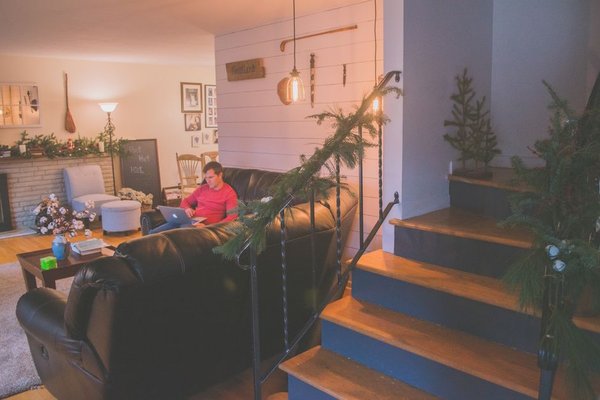
What makes diy christmas home decor look intentional?
Good diy christmas home decor uses a small number of high-impact projects, a measured three-color plan, and decorations sized to the actual room. Concentrate handmade pieces at the tree, mantel, dining table, and entry, keep walkways clear, and make reusable items flat-folding or nestable so they are practical after December.
The easiest way to make seasonal decorating look considered is to control repetition, scale, and placement before adding more objects. Use a few large projects and keep tiny craft clusters to a minimum; the same approach works across diy home decor throughout the year.
Which DIY Christmas home decor projects have the most impact?
The highest-impact projects change a large visual area or repeat through more than one part of the room. Start with one focal project, add one repeated motif, then stop before every horizontal surface becomes a display zone.
- Oversized paper stars: Make three to five stars between 16 and 28 in across and group them over a mantel, console, or blank wall. They create a focal point without requiring many separate decorations and store almost flat.
- Fabric ribbon garland: Tie leftover fabric strips to cotton cord at 3 to 4 in intervals. A 6 to 8 ft run suits a standard mantel, while a 12 ft run can wrap a 7 ft tree.
- Wrapped-box tree base: Reuse sturdy shipping boxes and cover them with kraft paper or fabric from the chosen palette. Keep the largest box around 18 to 22 in wide so the group anchors the tree without blocking the path.
- Framed paper cutouts: Replace existing frame inserts with cut-paper trees, stars, or geometric snowflakes instead of buying seasonal wall art. Return the regular prints in January, making this practical affordable diy home decor.
- Reusable fabric stockings: Sew simple lined stockings from remnants and keep the silhouette consistent. A finished length of 18 to 20 in reads clearly on a mantel while folding easily into a storage bin.
- Branch-and-paper table arrangement: Place trimmed dry branches in a stable vessel and hang lightweight folded paper ornaments. Keep the finished arrangement no higher than 14 in if people need to see across the dining table.
- Large removable window stars: Hang two or three lightweight paper or card stars between 12 and 20 in across from removable hooks on the window frame. They deliver impact and can be flattened for storage.
For easy diy home decor, repeat one idea in two locations instead of starting a second craft style. The room feels more coherent, and there are fewer fragile pieces to pack away.
How do you choose a Christmas color palette with exact values?
Use three specified colors and give each one a job: a light base at about 60 percent, a deeper supporting accent at about 25 percent, and a concentrated seasonal accent at about 15 percent. Check physical paint or material samples in the room because screen hex values are useful for matching direction, not a substitute for viewing real finishes in daylight.
For the 60 percent base, use #EFEEE5, Benjamin Moore White Dove OC-17, on the room surfaces or existing background pieces that already sit close to that value.
#EFEEE5 · Benjamin Moore White Dove OC-17
South-facing light shows more of its yellow undertone, while north-facing light makes the gray component more visible. Let it account for roughly 60 percent of the visible palette.
For the 25 percent supporting accent, use #434B56, Benjamin Moore Hale Navy HC-154, on a limited number of large items such as ribbon, removable paper panels, or existing textiles.
#434B56 · Benjamin Moore Hale Navy HC-154
South-facing light reveals more of its blue character, while north-facing light makes it read denser and more gray-black. Keep it near 25 percent of the visible palette as the supporting accent.
For the final 15 percent, use #8A2728, Benjamin Moore Caliente AF-290, on small repeated details such as tags, paper ornaments, ribbon ends, or a few removable accents.
#8A2728 · Benjamin Moore Caliente AF-290
South-facing light makes this accent feel fuller and more luminous, while north-facing light can make it look deeper and slightly cooler. Limit it to roughly 15 percent of the visible palette.
Keep those percentages approximate rather than counting every ornament. The purpose is to stop three equal-strength colors from competing across the room and to make future replacements easier to match.
What proportions keep seasonal decor from taking over the room?
Scale the decorations to the architecture, then protect the clearances you use every day. One large display zone and two smaller supporting zones are usually enough for a living or dining room; leave the remaining surfaces substantially unchanged so the seasonal layer has somewhere to breathe.
For a typical mantel, make the main garland about the mantel width plus 12 to 18 in total for a slight drop at the ends. On a dining table, keep a centerpiece footprint to roughly one-third of the table length, and leave at least 12 in of usable depth for place settings on each occupied side.
- Tree edge to main walkway 30 in minimum
- Mantel garland extra length 12 to 18 in total
- Dining centerpiece maximum height 14 in
- Stocking finished length 18 to 20 in
- Large wall star diameter 16 to 28 in
Do not force a 7.5 ft tree into a circulation path simply because it fits the ceiling height. Measure the floor footprint as well: a full tree can occupy about 4 to 5 ft across at the base, so both base width and top clearance need to work in a tight room.
Which handmade decorations are easiest to store and reuse?
Flat, folding, nesting, and textile-based pieces are the easiest to keep because they use little storage volume and survive repeated packing. Favor designs that can return to the same room next year without depending on a dated slogan or a fragile one-season material.
Paper stars that collapse, fabric garlands that coil, stockings that fold, and frame inserts that slide into a large envelope are strong choices. Label one lidded bin by room and keep hanging hardware in a small pouch inside it; that prevents a simple project from becoming a search for hooks next December.
- Store flat: paper stars, cut-paper art, and window pieces between two sheets of corrugated cardboard.
- Roll loosely: fabric garlands and ribbons around an empty paper-towel tube to reduce hard creases.
- Nest by size: reusable boxes and sturdy containers, with smaller pieces inside larger ones.
- Keep hardware together: removable hooks, cord, clips, and spare ties in one labeled pouch.
The same storage discipline is useful for diy home decor for apartments, where closet depth and shelf height matter as much as style. Design the project around the container you actually have instead of assuming extra storage will appear later.
When does homemade Christmas decor not work well?
DIY projects stop being a good choice when the room is already tight, the material is unsafe around pets or young children, or the project needs permanent fixing that a rental does not allow. Oversized floor clusters, long low garlands, and delicate branches can look convincing in a photograph but become irritating when they narrow a 30 in walkway, catch on clothing, or sit within reach of a toddler. A dining centerpiece above 14 in may also photograph well while making conversation across the table awkward.
Do not hang heavy objects from removable hooks just because the package shows a generous load rating; use the product exactly as directed and keep breakable pieces away from traffic. Skip real flame near paper, fabric, dry branches, or hanging decorations. If a display needs new wiring, an added outlet, or changes to fixed electrical fittings, use a qualified electrician instead of turning it into a craft project. In a rental, favor freestanding, removable, and existing fixing points so January cleanup does not leave wall damage behind.
Frequently asked questions
How many DIY Christmas decorations should I make for one room?
Start with one focal project and two smaller supporting areas. If the tree, mantel, and one table or entry surface carry the theme, the room already has enough seasonal structure.
What materials are best for reusable Christmas crafts?
Fabric, heavyweight paper stored flat, sturdy cardboard, cotton cord, and reusable frames pack easily. Avoid materials that shed, crack easily, or need a new adhesive setup every year.
Can I make Christmas decor without painting the walls?
Yes. Use removable paper art, textiles, ribbon, freestanding branches, frame inserts, and approved removable hardware. The work stays reversible, which is especially useful in a rental.
How early should I start making Christmas decorations?
Begin a few weeks before you plan to decorate if you are making several matching pieces. Finish one prototype first so you can confirm its size, hanging method, and storage plan.
How can I keep homemade Christmas decor from looking cluttered?
Repeat the same shapes, keep the palette to three specified values, and leave some everyday surfaces untouched. Use larger pieces in fewer zones and avoid scattering many small items around the room.
Good diy christmas home decor is less about making everything and more about choosing a few projects that have enough scale to matter. Measure first, repeat a controlled palette, protect normal circulation, and favor pieces you can pack efficiently so the work earns another season.