
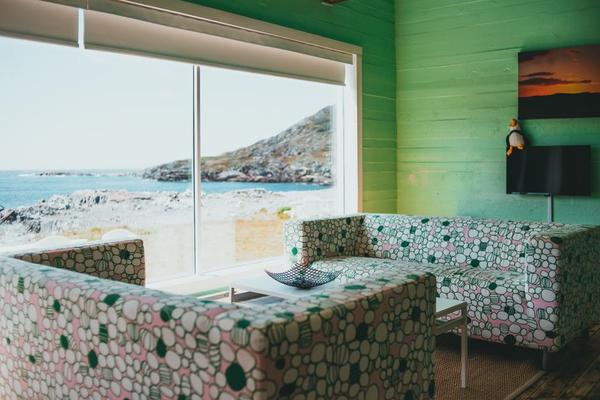
How do I choose sea green colour paint for a room?
Choose sea green colour paint by deciding whether the room needs a greener or bluer cast, then testing real samples beside your flooring and trim. North-facing daylight generally makes these shades cooler and grayer; south-facing light makes them warmer. Start with a mid-light blue-green and check it morning, midday, and evening before buying gallons.
Sea green can give walls noticeable color without making them feel visually heavy. Its success depends less on the name on a paint can than on the sample beside your flooring, trim, and everyday lighting.
What does sea green mean in interior paint?
Sea green is paint that visibly combines green and blue, with either hue able to lead. There is no single standardized formula. Manufacturers offer different versions, and digital previews cannot accurately predict wall color. Compare physical samples for the green-to-blue balance; use light reflectance value (LRV) as a rough indicator of how much light a finish reflects.
The wider green paint colours guide explains related families. Here, the focus is the narrow group whose blue component can become more obvious as the room light changes.
How blue or green should a sea green paint look?
A balanced sea green should appear recognizably green while retaining some blue character, without looking like saturated turquoise. Favor a greener candidate where daylight already feels cool, and test a bluer candidate only after checking it against fixed finishes.
Sherwin-Williams Sea Salt SW 6204, with a digital reference of #CDD2CA, is a restrained starting point for main walls. Its low saturation creates a clear background, but away from direct sun it can seem distinctly gray.
#CDD2CA · Sherwin-Williams Sea Salt SW 6204
North-facing light can make it grayer and cooler; south-facing light often reveals more green. Give it approximately 60 percent of a room’s visible color when used on the main walls.
For a slightly more aquatic appearance, consider Benjamin Moore Palladian Blue HC-144, represented by #C1D1C9. Place its physical sample next to the first candidate on the same wall; their undertones matter more than their names.
#C1D1C9 · Benjamin Moore Palladian Blue HC-144
Cool north-facing light can emphasize its blue character; south-facing sun often brings out more green. Use it as an alternative main-wall shade over roughly 60 percent of visible color.
| Selection question | Sea Salt SW 6204 | Palladian Blue HC-144 |
|---|---|---|
| Overall reading | Restrained green-gray | More aquatic blue-green |
| North-facing daylight | May look distinctly grayer | Blue can become clearer |
| South-facing daylight | Green appears stronger | Green can become warmer |
| First physical test | Against installed flooring | Against trim and curtains |
Neither is automatically better. Browsing pale green paint colours on a screen cannot replace samples: windows, neighboring buildings, and lamps change how both finishes read.
Which rooms suit sea green best?
Living rooms, bedrooms, and bathrooms can all use sea green when doors, fixtures, and furniture have enough contrast against it. Rooms with consistent daylight and uninterrupted walls usually make undertones easier to judge.
Choose the main test wall for the room, not the wall that happens to catch the best light in a photograph. Move the same sample to another surface before committing to every wall.
Sherwin-Williams Rainwashed SW 6211, digitally approximated by #C2CDC5, is another candidate for a bedroom or bath where a quieter green emphasis is wanted. Select an interior coating suitable for the room’s cleaning and humidity conditions.
#C2CDC5 · Sherwin-Williams Rainwashed SW 6211
North-facing light may make it flatter and grayer; south-facing light can reveal more green. As an alternative main-wall finish, allow about 60 percent of visible room color.
| Room | Best place to sample | Practical check |
|---|---|---|
| 12 x 15 ft living room | Longest uninterrupted wall | View beside the main sofa and floor |
| Bedroom | Wall behind the bed | Use the bedside lamps after dark |
| Bathroom | Wall adjoining fixed tile | Choose a coating rated for moisture |
| Entryway | Wall opposite the doorway | Check under the lights normally used |
More room-specific choices appear in green bathroom paint colours. The name of a color cannot tell you whether the finish will handle a shower-adjacent wall.
What colors pair well with sea green walls?
Give sea-green walls a deliberately specified trim color, then repeat that finish around doors and baseboards. As a visual guide, assign about 60 percent of the room to the wall color, 30 percent to ceiling and trim, and 10 percent to accessories repeating colors already present.
Sherwin-Williams Pure White SW 7005, digitally shown as #EDECE6, offers a defined ceiling and trim candidate. Sample the combination at the wall junction, where a slight undertone mismatch becomes easiest to see.
#EDECE6 · Sherwin-Williams Pure White SW 7005
North-facing light may cool its appearance; south-facing light tends to warm it slightly. Aim for roughly 30 percent of visible room color across ceilings, doors, and trim.
The 60/30/10 distribution is not a paint-quantity formula. Existing floors and furniture already occupy much of the room’s visual area. Check large samples against those permanent surfaces before buying accent fabrics.
| Room element | North-facing test | South-facing test |
|---|---|---|
| Sea-green walls | Watch for a blue-gray reading | Look for stronger green in sunlight |
| Pure White ceiling and trim | Confirm clear wall edges | Check for warmer-looking trim |
| Installed flooring | Hold the wall sample at floor level | Repeat out of direct sunlight |
| Curtains and upholstery | View fabric beside the sample | Check the same pairing at midday |
For another direction, sage green paint colours explores more gray-based greens; blue green colour paint focuses on stronger blue influence. Sample rather than combining two close green paints automatically.
How does sea green shift between north- and south-facing light?
North-facing windows generally provide cooler, more diffuse daylight, which can turn a blue-green darker or grayer. South-facing rooms often receive stronger, warmer light, bringing green forward as the sun moves.
Window direction is a clue, not a guarantee: trees, overhangs, neighboring buildings, and window glass all affect daylight. A large unshaded north window can illuminate a room better than a south window facing a tall building.
Keep the bulbs you intend to use after painting. Check blue green colour paint samples at breakfast, midday, and after sunset from your doorway; a shade that works at all three times is safer than one that photographs beautifully only at noon.
How large should a sea-green paint sample be?
Make your sample large enough to read as a surface instead of a tiny chip. Apply the manufacturer’s recommended coats to movable boards and hold them upright beside the floor, door casing, and largest upholstered piece.
For a rental, avoid wet patches or adhesives that could damage the wall; use manufacturer sample cards supported on furniture. Obtain permission before repainting anything permanently.
- Sample board width 24 in
- Sample board height 24 in
- Distance from wall corner 12 in minimum
- Gap between sample boards 6 in
- Normal sample viewing distance 6 ft
Move the boards to two walls and view them from the doorway. A color chip held near your face cannot predict the effect of an entire painted room.
When is sea green a poor choice for a room?
Sea green is a bad shortcut for a dim room if you expect paint alone to create daylight. Under a shaded north-facing window, even a mid-light blue-green may look dull and gray for most of the day. Large, styled photographs often hide this by using bright supplemental lighting, carefully edited exposures, and rooms without everyday clutter. Those images are not reliable paint tests.
It also struggles where the fixed flooring, tile, or cabinetry has an undertone that makes the wall color look accidental. If replacing those finishes is outside your budget, sample against them first; do not assume a new rug will repair every mismatch. In very narrow rooms, a dramatic ceiling-to-wall treatment can erase useful visual boundaries rather than create space.
For rentals, painting without approval is not a clever temporary solution. Use movable samples, washable textiles, or an approved paint change only. In homes with children or pets, prioritize a washable coating that suits the surface. The prettiest low-sheen photograph will not make a difficult-to-clean wall practical.
Frequently asked questions
Is sea green a cool paint color?
Usually it reads cool because blue is present, but the exact mix matters. Judge a physical sample at the wall because daylight and surrounding finishes can emphasize different parts of the color.
Should the ceiling be painted the same color as the walls?
It can be, but a distinct ceiling-and-trim finish makes edges easier to read in many rooms. Sample both coatings together before committing to full coverage.
Does sea green work with existing wood floors?
It can, provided the paint sample looks intentional beside the actual floor in daylight and evening light. Compare a large board at floor level instead of relying on a phone photograph.
What paint sheen is easiest to maintain?
Washable eggshell or satin coatings often suit busy walls, though performance varies by product. Check the manufacturer’s cleaning guidance; higher reflectivity can also reveal wall defects.
Can a hex code guarantee a paint match?
No. A hex code describes a digital reference, not how pigment will appear on a particular wall. Order a physical sample and observe it under your room’s lighting before buying gallons.
The right sea green keeps its intended blue-green balance beside your fixed finishes throughout an ordinary day. Test large samples, choose a defined trim finish, and let your room’s actual light settle the decision.