
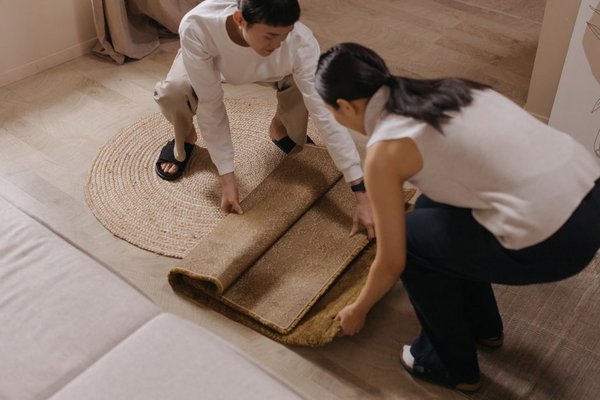
How do you arrange layered rugs living room without bunching?
For layered rugs living room layouts, put a larger, flat, securely padded rug beneath a smaller, low-profile accent rug. Keep the base rug under the sofa’s front legs, leave a visible border around the top rug, and use a rug-on-rug gripper rated for both backings. Avoid stacking thick piles, which creates ridges and trip points.
Layering works when both rugs have a clear job: one defines the seating area, and the other adds texture or pattern. Before buying the second rug, measure the room and check where feet, chair legs, and the vacuum will cross the overlap.
Which rug should be larger when layering rugs in a living room?
The bottom rug should be larger because it anchors the sofa and chairs as one seating group. The top rug is an accent, not a substitute for a correctly sized base.
For a 12 x 16 ft living room, begin by taping a 9 x 12 ft rectangle on the floor, with its long side parallel to the sofa. Place the sofa’s front legs on that rectangle and aim for the rug to extend at least 6 in beyond each end of the sofa. A 5 x 8 ft accent can sit inside the base, provided no high-traffic path runs directly across its outer edge.
Think of the lower layer as the actual living room rug. If it would look undersized on its own, adding a smaller rug will underline that mistake. Check a living room rug layout before buying if the seating area is offset from a doorway or fireplace.
Match the rug footprint to furniture, not empty floor
Sketch the sofa, chairs, and coffee table as rectangles, then mark their legs. At least the front legs of the main seating pieces should rest on the base without teetering on its bound edge. Keep side-table feet entirely on one surface; a table balanced half on and half off a rug can wobble.
How much of the bottom rug should show?
Leave roughly 12 to 24 in of the base visible along the most noticeable sides of the accent rug. The border need not match on every edge, but it must be wide enough to read as an intentional layer.
With a 9 x 12 ft base and a 5 x 8 ft top rug, centered placement leaves 24 in of the base visible along all four sides. You can shift the accent about 6 to 12 in toward the coffee table or favored chair, provided its edges stay clear of the walking route. Use painter’s tape on the floor to test the arrangement before unrolling either rug.
Which materials layer well without bunching?
Choose a stable, low-pile base with a top rug that lies flat under normal foot traffic. Backing, thickness, and edge construction matter more than whether the two rugs share a pattern.
| Rug material | Useful layering role | Likely bunching or care issue |
|---|---|---|
| Flatweave jute | Textured, low-profile bottom layer | Coarse fibers can shed; some backings grip poorly |
| Low-pile wool | Stable base or smaller woven accent | Thick binding can make a raised seam |
| Thin cotton flatweave | Lightweight accent over a secure base | Can wrinkle or migrate without rug-on-rug grip |
| Natural cowhide shape | Irregular accent away from walkways | Tips may curl and become toe-catching edges |
| Washable low-pile synthetic | Practical accent for frequent spills | Flexible fabric may ripple after washing |
A jute rug living room scheme adds texture, but check the actual weave: rough raised loops or stiff curling corners are poor candidates beneath a second rug. For a cowhide rug living room look, reserve the irregular piece for a low-traffic area. Some boho rugs for living room have tassels; keep those away from chair wheels and table feet.
If the surrounding walls need a specific paint reference alongside textured floor coverings, use Benjamin Moore Pale Oak, approximately #D8CFC4. Apply it to the walls and ceiling, about 60 percent of the room’s visible surfaces, leaving roughly 40 percent for furniture, textiles, and flooring.
#D8CFC4 · Benjamin Moore Pale Oak
Reads warmer and slightly pink in south-facing light but noticeably grayer in north-facing light. Use it for roughly 60 percent of the room on walls and ceiling, and check a physical paint sample before committing.
How do you layer rugs under a sofa and coffee table?
Put the larger rug down first, anchor it beneath the seating, then position the accent where people look rather than repeatedly walk. Keep the coffee table fully supported and maintain a comfortable gap between its edge and the sofa.
- Base rug in a 12 x 16 ft living room 9 x 12 ft
- Accent rug within that base 5 x 8 ft
- Visible base border when centered 24 in per side
- Sofa front-leg overlap on base 6 to 10 in
- Sofa seat edge to coffee table 16 to 18 in
- Unobstructed main walkway 30 in minimum
A step-by-step setup that stays flat
- Map the traffic: Walk from the doorway to each seat and mark the paths with removable painter’s tape. Keep the accent edge away from spots where feet turn or pivot.
- Measure the furniture: Record the sofa width, chair-leg positions, and coffee-table footprint. Use a tape measure rather than choosing sizes from a product photograph.
- Prepare the floor: Vacuum or sweep, let the floor dry, and follow the flooring maker’s guidance on acceptable pad materials. Grit trapped beneath a rug can abrade some finishes.
- Secure the base: Lay a floor-compatible non-slip pad beneath the larger rug, trimming it about 1 in inside the edges. Smooth the base from its center outward before returning the furniture.
- Set the accent: Place the second rug on a rug-on-rug gripper designed for both textiles; do not assume a hard-floor pad works between rugs. Smooth the entire surface and inspect each corner.
- Test in use: Return the coffee table, walk the normal routes, sit in each chair, and push a vacuum across the layers. Reposition the accent if its edge catches, puckers, or moves.
A second check of living room rug measurements can help before ordering. For an irregular accent, the cowhide rug living room guide gives its footprint more focused attention.
How do you keep layered rugs from sliding?
Use two different gripping interfaces: a pad rated for the floor beneath the base, and a rug-on-rug product between the layers. Neither should protrude beyond the rug edges or be used against its maker’s instructions.
- Check the pad label: Confirm compatibility with the floor finish and both rug backings.
- Keep the pile low: A compressible base can make an upper rug buckle under shifting furniture weight.
- Remove unstable edges: Move a curling rug out of traffic instead of hiding a corner under furniture.
- Repeat the walk test: Inspect after cleaning and whenever the sofa or coffee table moves.
When is layering rugs a bad idea in a living room?
Skip the second rug if the room’s only walking route crosses a raised edge every time someone enters. In a narrow space with less than 30 in of clear passage, the extra border can become a trip hazard rather than a decorating choice. The same is true if a mobility aid must roll over the overlap or if chairs slide across it daily.
Photographs of thick rugs stacked under a coffee table often hide the problem: the surface compresses differently wherever feet or furniture land. Plush pile under another rug can wrinkle, trap debris, and make a lightweight table wobble. It may look appealing for one still image and perform badly in an occupied room.
Homes with active pets or young children need caution. If a pet can pull up the top rug while running, or a toddler catches its corners, remove that layer until you have a genuinely stable setup. In a rental, do not compensate with permanent adhesive, staples, or screws. One correctly sized rug is better than two rugs that cannot be secured without damage.
Frequently asked questions
Can you layer rugs over wall-to-wall carpet?
Yes, but the carpet must be firm enough that the upper rug does not ripple as people walk. Use a gripper specifically rated for rug-over-carpet applications and test the edges in everyday use.
Should the coffee table sit on both rugs?
Ideally, all its legs should rest fully on the accent or on the base, not straddle a raised edge. A fully supported table is steadier and easier to clean around.
Can a washable rug be the top layer?
Yes, if it lies flat after laundering and has a compatible rug-on-rug grip underneath. Check the manufacturer’s care instructions and do not replace it while its backing is damp.
Is it okay to angle the smaller rug?
A slight angle can work when it keeps the edges outside walking paths and table-leg positions. Test it with tape first because a dramatic diagonal exposes more corners to catch.
How often should you lift and clean layered rugs?
Vacuum the exposed surfaces according to manufacturer instructions and lift the accent regularly to remove trapped grit. Check the pads and backing at the same time for slipping, discoloration, or moisture.
Successful layering is mostly geometry and friction, not styling tricks. Start with a properly sized lower rug, test the smaller one under real foot traffic, and remove any layer that refuses to stay flat.