
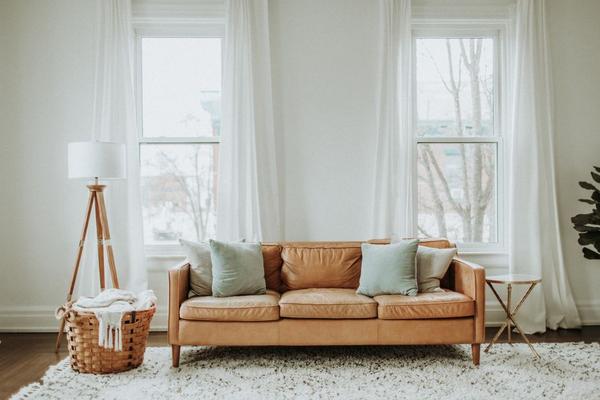
What is the best method for placing rugs in living room seating areas?
For placing rugs in living room seating areas, center the rug on the furniture grouping rather than the walls. Put at least the sofa’s front legs and the chairs’ front legs on it, extend the rug 6 to 12 inches beyond the sofa sides, and keep the main walking route unobstructed.
A rug should make a seating arrangement feel like one usable area, not create an obstacle between the sofa and doorway. Before moving furniture, measure the grouping and mark the proposed rug outline with removable painter’s tape.
Place the rug step by step
Use this sequence before buying. Include the depth of each chair when someone is seated, not just the footprint of empty furniture.
- Measure the seating zone: Record the outermost sofa and chair legs. Include end tables inside the grouping, but exclude the normal route to doors, stairs, or adjoining rooms.
- Choose your anchor: Use the sofa’s centerline as a starting point. The rug should connect the people sitting together, even if the sofa is not centered on the wall.
- Tape the outline: Mark the rug’s full width and length with removable tape. Stand at the doorway, then sit in every chair to inspect the arrangement.
- Position the sofa: Set the front legs 6 to 10 inches inside the rug edge. Keep both front legs supported, rather than balancing one leg on the binding.
- Bring in the chairs: Place the chair front legs securely on the rug. Sit down and stand up to confirm that no rear leg rocks or catches its edge.
- Set the coffee table: Keep all table feet on the rug and measure 16 to 18 inches from the sofa cushion front to the table edge.
- Check the walking route: Walk through the room, test door swings, and preserve a clear passage. Use a floor-compatible rug pad and check that corners lie flat.
Where should you place a rug under a living room sofa?
Put the sofa’s front legs on the rug, with roughly 6 to 10 inches of rug beneath them. Center the rug on the sofa’s seating width and aim for 6 to 12 inches of rug extending beyond each arm when the floor plan allows.
A 7-foot sofa measures 84 inches wide. Centered on an 8-foot-wide rug, it has 6 inches of rug visible at either end; on a 9-foot-wide rug, the visible amount becomes 12 inches. Measure the sofa arms, not just the seat cushions, to avoid an awkwardly narrow strip.
Check the whole living room rug plan before finalizing the sofa position. With a sectional, align the rug with the active seating area rather than blindly following the longest wall.
Should chairs sit fully or partly on the rug?
At minimum, place both front legs of each lounge chair on the rug. If a rear leg sits on the binding, move the chair forward or use a rug large enough to keep the chair stable when someone changes position.
For a swivel chair, test its complete turn; for a rocking chair, check the full arc. Leave about 8 inches behind a stationary chair where space permits, so the back legs do not perch on a thick edge.
Sketch the living room rug layout from above, even as rectangles on paper. Facing chairs about 4 to 8 feet apart can support conversation; measure the clear distance between their front edges rather than guessing from a photograph.
How do you place a rug under a coffee table?
Set all four coffee-table feet on the rug, centered within the seating group. Keep approximately 16 to 18 inches between the front of the sofa cushion and the nearest table edge to allow both passage and comfortable reach.
For a 24-by-48-inch coffee table, first position the table, then measure out to the sofa and chair legs. A small rug holding only the table fails to join the seating into one area. With a round table, tape its full diameter and check its clearance from chair knees.
How do you align a rug in a long living room?
Align the rug with the sofa and chairs forming one conversation area, not automatically with the entire room. Usually its longer edge runs parallel to the main sofa, even when the sofa sits toward one end of a rectangular room.
In a 12-by-20-foot room, let the rug define a specific seating zone. The rest of the floor can remain open for circulation or a separate reading chair.
For layered rugs living room plans, tape both outlines. Keep the top rug flat and the base rug away from chair pivot points; an unsecured layer that slides during normal use is not a successful arrangement.
How much space should stay clear around the rug edges?
Start with 12 to 24 inches of visible floor between the rug and nearby walls where the layout permits. Keep a main walking passage around 30 inches clear, measured between furniture and other obstacles, rather than treating the rug border as a walkway.
Open nearby doors fully and check for floor vents or furniture corners along the route. Record your living room rug measurements before ordering so you can repeat the taped layout accurately.
- Front sofa legs inside rug edge 6 to 10 in
- Rug beyond each sofa arm 6 to 12 in
- Sofa cushion to coffee table 16 to 18 in
- Main passage around furniture 30 in clear
- Visible floor at nearby walls 12 to 24 in
Check centered rugs against actual room sizes
This table shows the exposed floor border when a rug is centered in an otherwise empty rectangular room. It is a size check, not proof that your furniture or walking route will fit.
| Room floor size | 8 x 10 ft rug: border on each side | 9 x 12 ft rug: border on each side |
|---|---|---|
| 11 x 14 ft | 18 in across width; 24 in at ends | 12 in across width; 12 in at ends |
| 12 x 15 ft | 24 in across width; 30 in at ends | 18 in across width; 18 in at ends |
| 13 x 16 ft | 30 in across width; 36 in at ends | 24 in across width; 24 in at ends |
| 14 x 18 ft | 36 in across width; 48 in at ends | 30 in across width; 36 in at ends |
How can the rug work with the wall color?
Once the taped arrangement functions, check the rug against the room’s actual daylight. Benjamin Moore Pale Oak, approximated on screen by #D8CFC4, is one paint reference to sample beside the rug; confirm its appearance from a physical swatch, not a phone screen.
#D8CFC4 · Benjamin Moore Pale Oak
South-facing daylight makes it read warmer and slightly pink, while north-facing light pulls it grayer. Use it on walls and ceiling for roughly 60 percent of the visible room surfaces, after checking a physical sample.
Let furniture placement and clear paths make the final decision. Coordinated colors cannot compensate for a corner that catches feet each time someone crosses the room.
When does a large, perfectly centered rug not work?
A large centered rug can look convincing in a staged photograph while making an occupied room harder to use. This is common in a narrow living room with a doorway near one corner. The rug appears balanced from the camera angle, but people cut across a loose edge each time they move between rooms.
Do not force a 9 x 12 ft rug into a room where a door drags across the pile or the chair blocks a passage. Choosing a smaller size is sensible only when the remaining furniture sits securely and the grouping still feels connected. In a rental, do not use permanent tape, glue, or fasteners on the floor. Use removable tape briefly for planning, then choose a nonstaining pad approved for the floor finish.
Pets, toddlers, walkers, and rolling mobility aids make curled corners and loose layered rugs serious concerns. A decorative top rug that shifts underfoot is not worth keeping. If the seats cannot be stable and the route cannot stay clear, leave part of the floor uncovered. Function matters more than a symmetrical photograph.
Frequently asked questions
Can a rug be smaller than the sofa?
Yes, although the sofa’s front legs should still be supported if possible. Tape the proposed width on the floor to see whether the outer seats look disconnected.
Should a rug go beneath a sectional chaise?
Try to include the chaise’s front support within the rug footprint. If it falls beyond the edge, keep its legs stable and the edge out of the usual walking route.
Do I need a rug pad on hardwood floors?
Choose a pad specifically compatible with the floor finish and rug backing. Consult the flooring manufacturer’s care guidance, since some pad materials can leave marks.
Can an area rug cover a floor vent?
Keep vents uncovered so the air can flow freely. Move the rug outline instead of positioning the binding or pad over the opening.
How can I test a rug size before ordering?
Mark the full rug outline using low-tack removable tape. Walk the normal route, open nearby doors, and sit in each chair before choosing the size.
Measure the furniture first, tape the full rug footprint, and test the arrangement before placing an order. A well-positioned rug connects the chairs, keeps the table within reach, and leaves the room safe to cross.